
🚨🚨🚨 the SEC released updated guidance on token buybacks 🚨🚨🚨
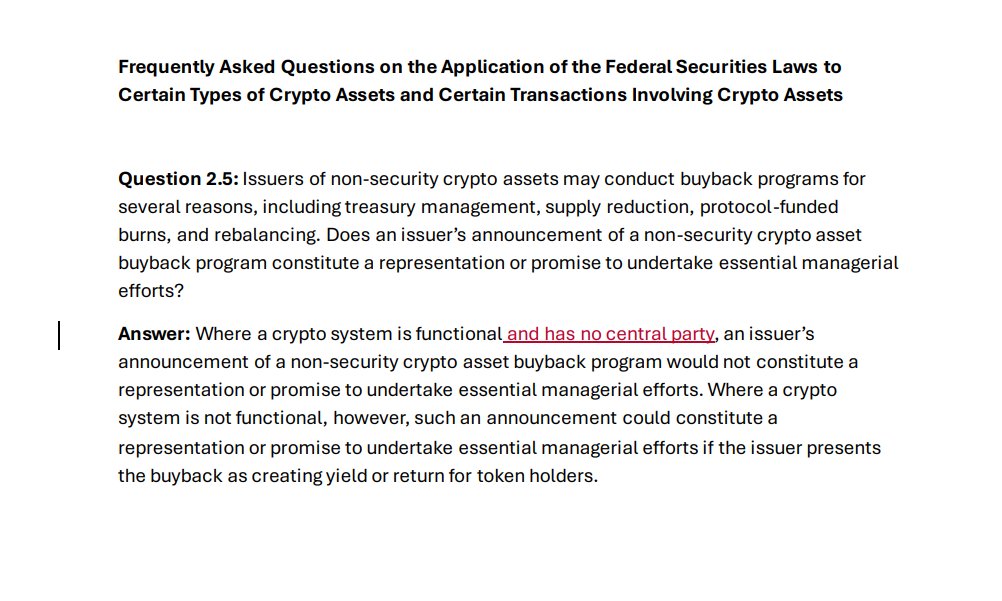
it seems there is a decentralization premise here after all
here is the redline
sec.gov/files/frequent…
it seems there is a decentralization premise here after all
here is the redline
sec.gov/files/frequent…
Sep 28, 2026 · 6:30 PM UTC
35
22
227
35,452

@lex_nodee wondering what constitutes a "central party", the SEC's defines a “central party” as a person, entity, or group of persons or entities having operational, economic, or voting control of a crypto system. A crypto system can be either an L1/L2 or a software app running on an L1/L2
4
1
29
4,580


Cold outreach starts with a list of people who did not ask.
This starts with a post from someone who did.
One sentence in. Buyer posts out.
outx.ai/?utm_source=tw…
This starts with a post from someone who did.
One sentence in. Buyer posts out.
outx.ai/?utm_source=tw…
2
1
13
77,935

@lex_node Miles jennings complained so much they answered his call
0
0
6
358

@lex_node im so happy crypto companies - who’ve historically struggled to stay afloat - can keep spending all their revenue making their shitcoins going up 😭😭😭
0
0
3
280


@lex_node If there is no central party, which issuer can announce the buyback?
0
0
2
281

@lex_node "No" central party - how centralized do they have to be? Seems like the mere power to implement a (non-programmatic) buyback program would be indicia of centralization, no?
0
0
1
229


@lex_node does a team that holds the upgrade keys or picks the oracle count as a central party? that's still most networks
0
0
0
22

@lex_node So why was everyone led to believe that it was ok?
0
0
0
137

Year one of a startup: no revenue, no proof of demand.
Year one of a business you buy: paying customers, a track record, a seller who shows you the ropes.
Same year. Very different start.
Learn how from 1,300+ verified members of our free community. searchers.com/start?utm_sour…
Year one of a business you buy: paying customers, a track record, a seller who shows you the ropes.
Same year. Very different start.
Learn how from 1,300+ verified members of our free community. searchers.com/start?utm_sour…

2
0
29
27,605


@lex_nodenueva es “and has no central party”. El resto del FAQ no se ha vuelto un salvo conducto.
Si el emisor anuncia el programa, el mercado compra por esa promesa. Da igual que el día del anuncio no haya un contrato firmado.
El test no es el PDF. Es si, quitando al equipo, el buyback seguiría existiendo.
En la mayoría de tokens, no....
Si el emisor anuncia el programa, el mercado compra por esa promesa. Da igual que el día del anuncio no haya un contrato firmado.
El test no es el PDF. Es si, quitando al equipo, el buyback seguiría existiendo.
En la mayoría de tokens, no....
0
0
0
212


@lex_node Was always there in the Interpretative Release imo, just clearer now.
To be a non-security, you need to be a Digital Commodity.
Digital Commodity requires that the system is "functional"
Functional requires no central party.
To be a non-security, you need to be a Digital Commodity.
Digital Commodity requires that the system is "functional"
Functional requires no central party.

1
1
15
512

@lex_node most projects are just wrappers for a central dev team anyway
0
0
1
110


@lex_node yeah, but watch protocols hard-code buybacks instead of letting a multisig freestyle them. same bid, smaller howey target 🐸
0
0
1
105

@lex_node”however” in the second sentence of the answer makes that sentence stand in contrast with the first sentence of the answer, yet the scenario descriptions in each sentence are not written in perfect opposition to each other.
The scenario descriptions are:
“Where a crypto system is functional and has no central party...”
VS
“Where a crypto system is not functional...”
The scenario descriptions are NOT:
“Where a crypto system is functional and has no central party...”
VS
“Where a crypto system is not functional or has a central party…”
Do you read this as implying that for a system to be functional it must have no central party? Otherwise, why would the SEC staff find it unnecessary to include “or has a central party” in the second sentence?
0
0
0
21

@lex_node worth noting Q2.4 already said "once a functional crypto system has no central party". Q2.5 was the odd one out. reads less like a new premise and more like staff fixing an inconsistency they missed
0
0
0
8

@lex_node The SEC updated its crypto FAQ Friday: token buybacks on operational networks are not securities transactions. Small guidance, but a big signal — staff keeps narrowing what counts as a security.
0
0
0
137


@lex_node The real question is how many current “crypto systems” can actually fit that description?
0
0
0
157

@lex_node oh i guess that’s the exact thing a16z crypto’s policy head trashed the other day! 👀

0
0
0
187
