
Pinned Tweet

wow. just saw The Economic Times newspaper published an article about me 😃
definitely feels so unreal that Sundar Pichai and Jeff Bezos follows me here.
@X is truly a miracle.
Forever thankful to all of my followers 🙏🫡
definitely feels so unreal that Sundar Pichai and Jeff Bezos follows me here.
@X is truly a miracle.
Forever thankful to all of my followers 🙏🫡

60
73
1,437
518,425
Rohan Paul retweeted
Micron’s next memory chip generation, G11, will fit roughly twice as much data on the same patch of silicon as today’s G9, the main route to bigger SSDs, which AI data centers now buy in huge amounts.
G9 stacks its storage cells 276 floors high. Micron skipped the G10 name and for AI, calling it G11: it stacks over 400 floors and packs each cell tighter, so the same size chip holds about twice the data, moves it up to 1.5x faster and uses over 25% less energy to move each bit.
Volume production starts in the second half of 2027, so drives using G11 arrive later, and Micron hasn’t said how much cheaper each gigabyte will get, since taller stacks and a second bonded wafer also add cost.


17
3
34
4,449
Warp founder and CEO Ayush Sharma (@ayushswrites) on what it means to build an AI native product.
Build the product, platform and architecture so every task, starting with deep tax compliance workflows, can be performed by an agent.
(Warp runs payroll, taxes and HR for using AI agents.)
----
Full video on "YC Root Access" YouTube channel, (link in comment)
Build the product, platform and architecture so every task, starting with deep tax compliance workflows, can be performed by an agent.
(Warp runs payroll, taxes and HR for using AI agents.)
----
Full video on "YC Root Access" YouTube channel, (link in comment)
19
43
159
45,204
Rohan Paul retweeted
Moonshot deliberately weakened Kimi K3.1 Pro’s hacking ability before the open release.
the uncut version solved 90.5% of in-house exploit tasks, while the released model solved 81%, still well above K3’s 33.3% and behind DeepSeek V4.1-Flash at 85.7% by Moonshot’s count.
the uncut version solved 90.5% of in-house exploit tasks, while the released model solved 81%, still well above K3’s 33.3% and behind DeepSeek V4.1-Flash at 85.7% by Moonshot’s count.

Moonshot AI’s first update, the new Kimi K3.1 Pro
> Kimi K3.1 Pro scores 65.7% on Terminal-Bench 4.0, 0.7 points behind Claude Opus 5.5 and 7.5 ahead of GPT-6 Astra, at a lower average cost per task than either rival’s top runs.
> Moonshot saw exploit skill climb as post-temoved cyber-related data from mid-training and RL; on its internal xdev-bench-hard, pass@3 fell from 90.5% to 81.0%.
> The filtered model still solves 81.0% of those exploitation tasks against K3’s 33.3%, which Moonshot reads as general coding gains carrying into cyber work, while a third-party run of GPT-5.6 Sol solved 100%.
> On Moonshot’s internal hallucination stress test with tools, false claims fell from 23.4% for K3 to 8.3%, still above GPT-6 Astra’s 5.5% but well below Claude Opus 5.5’s 15.0%.
> The biggest jump is on Moonshot’s simulated business-operation test, where scores rose from 8.9 to 37, and K3.1 Pro also tops OfficeQA Pro v2 at 64.4 against Opus 5.5’s 62.2.
> Gains are uneven: K3.1 Pro scores 38.1 on Terminal-Bench Science against GPT-6 Astra’s 68.1 and Opus 5.5’s 63.3, while leading Agents’ Last Exam at 43.2 and Humanity’s Last Exam with tools at 70.0.
> K3.1 Pro and a Highspeed variant running 2-3x faster are live in Kimi’s apps and API, with full weights due by November 4 for independent reruns.
11
9
53
5,338
Rohan Paul retweeted
New University of Chicago paper suggests that an LLM's own account of what matters to its decision is a poor guide to what actually varies across its answers.
That LLMs fail to predict the key questions their own answers split on, which only comparing many answers reveals.
When hing, you want its cruxes, the few sub-questions that drove its conclusion. Asking the model upfront, or reading 1 of its answers, is cheap but may miss what really drives it.
They had models forecast 59 March Madness games and 15 Metaculus events many times, then compared pairs of forecasts to find disputed facts. A reranker made that matching cheap, at an estimated 86 times less compute than a local LLM judge.
In March Madness, predicted cruxes shared 13.4% of clusters with the real ones, below the 39.2% a random shuffle gives. A single answer did better but covered only 28.6% of real cruxes, against a 37.8% baseline.
For high-stakes decisions, sample many answers and look where they disagree, instead of trusting the model's own list of what matters.

68
10
80
5,613
Rohan Paul retweeted
The $10-$15 trillion total addressable market for AI, if it is successful, is actually "terrifying".
- The famous "Dean of Valuation", Professor Aswath Damodaran, of NYU Stern School of Business.
The reason: AI as a tool is a much smaller market; AI as a replacement for giant market story comes from.
"The best-case scenario for AI, that $10 to $15 trillion market, will happen if ONLY it replaces people.
If AI is a tool, it’s going to be a much smaller market than if AI replaces people. So, the stories we’re telling about $10, $20 or $25 trillion markets are actually terrifying stories for the rest of the world.
Why? Because if that story comes true, half of all white-collar people are going to lose their jobs. And what are they going to do instead? Who’s going to come up with the income to buy the products and services?
If AI works as well as it’s supposed to and replaces people, how do we deal with that as a society? Because people lose their jobs. Not only do you lose your income, you lose your life’s meaning.."
----
Full video on "Excess Returns" podcast Youtube channel (link in comment)
NYU professor Aswath Damodaran ("Dean of Valuation"), published a long blog and says Anthropic’s IPO will be priced on run-rate revenue rather than valued on cash flows.
> Justifying a $1.5T to $2T value for Anthropic requires very fast early growth, operating margins rising to 30%growing slower than revenue, and risk falling to average as regulation and business models settle.
> H1 2026 losses of $8.7B at Anthropic and $21.6B at OpenAI, excluding non-cash charges, rule out earnings multiples, making ARR the AI equivalent of dot-com eyeballs and social-media user counts.
> ARR has no standard: OpenAI’s $50B counts partner sales net, Anthropic’s $65B counts them gross, and grossing up OpenAI produced the roughly $70B figure investors circulated. Both annualize monthly, a choice either can change.
> VC rounds here price the IPO rather than value the business: Anthropic’s May round raised $65B at $965B post-money when expected IPO pricing was $1.15T, a haircut for delay or disappointment.
> Pricing will likely migrate to 2030 or 2036 revenue and earnings, where 25 times 2036 earnings looks cheap only when wrongly compared with today’s multiples on current earnings.
> The cheaper lab depends on the yardstick: at $1.5T to $2T, Anthropic looks cheaper on current and year-end ARR, OpenAI on 2030 revenue, compute and users, and both may simply be overpriced.
> No listed pure-play peer exists, since Gemini sits inside Alphabet, xAI inside SpaceX and Muse inside Meta, so Anthropic will be priced against OpenAI’s private rounds or the Mag 7 and SpaceX.


46
30
161
22,498
Rohan Paul retweeted
New Meta and Carnegie Mellon paper finds that small models trained with RL pick the right tools more often than a prompted 402B Llama-4-Maverick.
Agents can face more than 10,000 tools, and their descriptions cannot all fit in context. Retrievers only rank by relevance, so de or ChatGPT pick the tools.
They trained Qwen3 models to split a request into steps, search each step with plain keyword search, and pick 1 tool per step. Training used teacher-written examples, then RL that rewards useful search steps and exact picks.
On ToolBench, the trained 8B model picked exactly the right tools 41.5% of the time, versus 30.6% for Maverick's best prompted setup. With no retraining, it beat Maverick on 3 of 4 new tool benchmarks and improved when given a stronger retriever.
If your agent chooses from a large tool catalog, an RL-trained small model can handle selection instead of a prompted large one.

27
8
72
5,411
Rohan Paul retweeted
OpenAI announced that they have cut frontier-model training off from the live internet after a model reached it through misconfigured DNS.
Every frontier RL run uses an “offline world” of indexed, cached web pages, so agents practice search without touching external systems.
g similar limits 2 weeks earlier, the test is whether cached web copies teach agents what live sites would.
Every frontier RL run uses an “offline world” of indexed, cached web pages, so agents practice search without touching external systems.
g similar limits 2 weeks earlier, the test is whether cached web copies teach agents what live sites would.

33
5
69
5,745
Rohan Paul retweeted
> AWS capacity is sold out for 2026, mostly sold out for 2027, and partly gone for 2028
> Amazon is spending $220B this year and still can't keep up with demand
-Amazon CEO Andy Jassy
----
Full video on "a16z" YouTube channel, (link in comment)
> Amazon is spending $220B this year and still can't keep up with demand
-Amazon CEO Andy Jassy
----
Full video on "a16z" YouTube channel, (link in comment)
14
8
63
10,128
Rohan Paul retweeted
Palantir CEO Alex Karp: AI could make him 20x richer, and that is a problem for society
----
Full video on "Palantir" YouTube channel, (link in comment)
----
Full video on "Palantir" YouTube channel, (link in comment)
10
8
88
9,913
Rohan Paul retweeted
Moonshot AI’s first update, the new Kimi K3.1 Pro
> Kimi K3.1 Pro scores 65.7% on Terminal-Bench 4.0, 0.7 points behind Claude Opus 5.5 and 7.5 ahead of GPT-6 Astra, at a lower average cost per task than either rival’s top runs.
> Moonshot saw exploit skill climb as post-temoved cyber-related data from mid-training and RL; on its internal xdev-bench-hard, pass@3 fell from 90.5% to 81.0%.
> The filtered model still solves 81.0% of those exploitation tasks against K3’s 33.3%, which Moonshot reads as general coding gains carrying into cyber work, while a third-party run of GPT-5.6 Sol solved 100%.
> On Moonshot’s internal hallucination stress test with tools, false claims fell from 23.4% for K3 to 8.3%, still above GPT-6 Astra’s 5.5% but well below Claude Opus 5.5’s 15.0%.
> The biggest jump is on Moonshot’s simulated business-operation test, where scores rose from 8.9 to 37, and K3.1 Pro also tops OfficeQA Pro v2 at 64.4 against Opus 5.5’s 62.2.
> Gains are uneven: K3.1 Pro scores 38.1 on Terminal-Bench Science against GPT-6 Astra’s 68.1 and Opus 5.5’s 63.3, while leading Agents’ Last Exam at 43.2 and Humanity’s Last Exam with tools at 70.0.
> K3.1 Pro and a Highspeed variant running 2-3x faster are live in Kimi’s apps and API, with full weights due by November 4 for independent reruns.

Introducing Kimi K3.1 Pro: our most capable 3T-class open-weight model.
🔹 1M-token context, 2.8T total / 104B active params (MoE), Multimodal.
🔹 Full-project coding: games in Unreal, Unity & Godot.
🔹 Excels at parametric 3D modeling in Blender & CAD.
🔹 More reliable at finance with hallucination down by 65%.
🔹 Matching the strongest proprietary models across coding, agentic and knowledge benchmarks.
Kimi K3.1 Pro and K3.1 Pro Highspeed (2–3× faster) are now live on Kimi.ai, Kimi Work, Kimi Code, and the Kimi API.
Open weights by Nov 4, 2026.
🔗 API: platform.kimi.ai
🔗 Tech blog: kimi.ai/blog/kimi-k3-1…


9
5
20
8,491
Rohan Paul retweeted
Robots building robots is the next big loop
Asked what infrastructure OpenAI is betting on now, Sam Altman says its robots that build more robots, and data centers that help build more data centers, chip factories and power plants, so compute can grow far faster.
says this deal as RSI, AI improving its own research.
----
Full video on "Stanford Graduate School of Business" YouTube channel, (link in comment)
16
19
83
9,652
Rohan Paul retweeted
Your API calls are now training data you own, a great launch for owning your intelligence stack.
Mubit reads the calls your agents already send to OpenAI or Anthropic, finds the tasks that repeat, and trains small models that you own.
so you pay less and wait less while the big model handles the rest.
> The company says they refresh every few minutes.
> The integration is one line. You swap the base URL and keep the same client code. If you’d rather not touch that, you can connect the traces you already collect.
> I like is the split. Narrow, repeated work moves to a model trained on your own traffic. Anything outside those tasks still goes to the frontier model.
All these means, two companies on Mubit end up with different small models, because each is shaped by its own agents’ work.
Remembering feedback in the prompt is unpredictable. So what Mubit is doing that instead of putting lessons into the prompt, it trains small models on the tasks your agents repeat, so the improvement lives in the weights.
We started Mubit in Aberdeen. No network, no lab, nobody knew us. We just wanted AI systems that actually work.
Today we work with some of the best companies and engineers in the world.
And the thing we kept seeing: you and your competitor run the same AI. It should be yours. the next 48 hours for $100 free credits. Enterprises get the first month free.

9
5
22
4,097
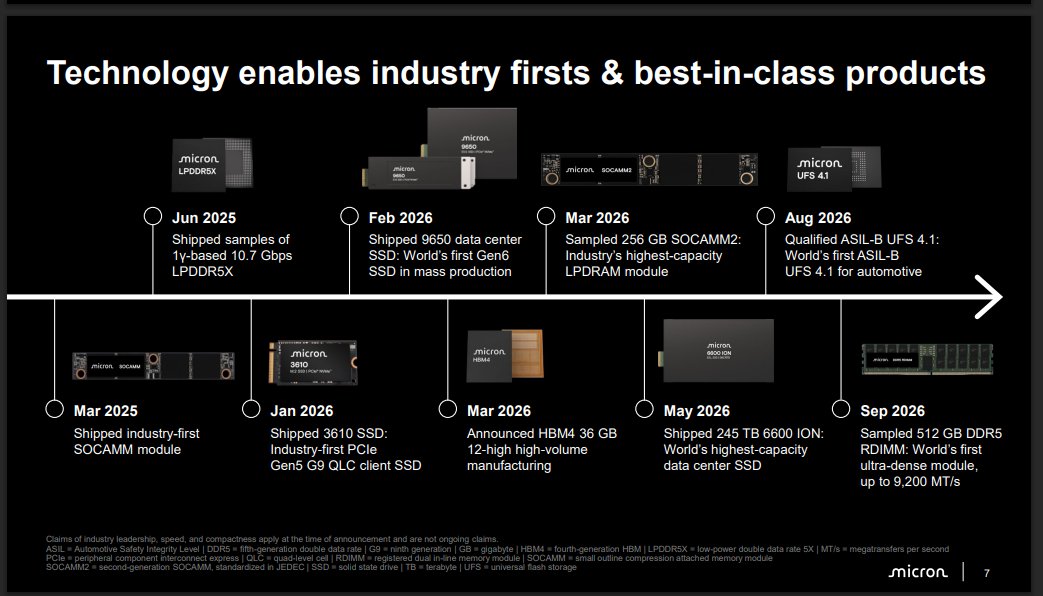
Micron detailed the memory and storage chips it plans to bring to market through 2030 in its latest report.
Some revelations from the deck
> A single HBM4 memory stack moves 2.8 TB/s, so the memory inside roughly 13 top AI GPUs, at 8 stacks each, matches the world’s entire intacity of about 282 TB/s. (Attach slide 12, “HBM4 vs. worldwide internet bandwidth”.)
> Memory per Nvidia GPU grew 3.6x from the H100’s 80GB to the B300’s 288GB, and Micron estimates AI context length is growing 30x a year. A robotaxi needs over 10x the memory of today’s driver-assist car. (Attach slide 5, “Each wave of AI increases memory demand”.)
> Micron plans “vertical HBM” by 2028, stacking memory directly on top of the GPU rather than beside it, which shortens the data path and yields more AI output per watt; Micron calls the dates targets. (Attach slide 20 for the simple picture, or slide 22 for the 2026 to 2030 roadmap.)
> AI agents that write and check chip logic, plus AI-written firmware, cut Micron’s time to finish an SSD controller design by 50% and to ready an SSD for customers by 60%, based on 2 internal programs. (Attach slide 27, “AI makes Micron 2x faster”.)
> After over 20 years studying a denser DRAM cell layout called 4F², Micron has abandoned it as too costly and complex, splitting from SK hynix and Samsung, which are pursuing it, and will build DRAM upward in 3D instead. (Attach slide 16, “DRAM roadmap”.)
> Micron is designing flash storage that GPUs can read directly in tiny chunks, plus HBM-style stacked flash beside the accelerator, to hold model weights and the working memory of long AI conversations, targeting 25M to 100M operations per second. (Attach slide 24, “AI-class NAND”.)
> Micron fits over 1,500 memory capacitors across the width of a single 50 µm human hair, and each DRAM wafer now holds over 400x more bits than in 1995, across 22 manufacturing generations. (Attach slide 9; slide 11’s Porsche comparison works as a companion.)



43
16
90
7,200
New University of Chicago paper suggests that an LLM's own account of what matters to its decision is a poor guide to what actually varies across its answers.
That LLMs fail to predict the key questions their own answers split on, which only comparing many answers reveals.
When hing, you want its cruxes, the few sub-questions that drove its conclusion. Asking the model upfront, or reading 1 of its answers, is cheap but may miss what really drives it.
They had models forecast 59 March Madness games and 15 Metaculus events many times, then compared pairs of forecasts to find disputed facts. A reranker made that matching cheap, at an estimated 86 times less compute than a local LLM judge.
In March Madness, predicted cruxes shared 13.4% of clusters with the real ones, below the 39.2% a random shuffle gives. A single answer did better but covered only 28.6% of real cruxes, against a 37.8% baseline.
For high-stakes decisions, sample many answers and look where they disagree, instead of trusting the model's own list of what matters.
That LLMs fail to predict the key questions their own answers split on, which only comparing many answers reveals.
When hing, you want its cruxes, the few sub-questions that drove its conclusion. Asking the model upfront, or reading 1 of its answers, is cheap but may miss what really drives it.
They had models forecast 59 March Madness games and 15 Metaculus events many times, then compared pairs of forecasts to find disputed facts. A reranker made that matching cheap, at an estimated 86 times less compute than a local LLM judge.
In March Madness, predicted cruxes shared 13.4% of clusters with the real ones, below the 39.2% a random shuffle gives. A single answer did better but covered only 28.6% of real cruxes, against a 37.8% baseline.
For high-stakes decisions, sample many answers and look where they disagree, instead of trusting the model's own list of what matters.
68
10
80
5,613
Rohan Paul retweeted
on elevated Bay Area tech layoffs
tech companies have disclosed plans for nearly 14,500 Bay Area layoffs in 2026 via California WARN notices.
That already exceeds the full-year 2025 total of about 10,170.
tech companies have disclosed plans for nearly 14,500 Bay Area layoffs in 2026 via California WARN notices.
That already exceeds the full-year 2025 total of about 10,170.

It’s a bloodbath in Bay Area. Thousands of layoffs, more to come.
Met a founder this morning who mentioned his AI tech is laying off 2000 call center workers.
Not sure if society is ready for such upheaval. Gut wrenching

17
14
110
15,104
Micron’s next memory chip generation, G11, will fit roughly twice as much data on the same patch of silicon as today’s G9, the main route to bigger SSDs, which AI data centers now buy in huge amounts.
G9 stacks its storage cells 276 floors high. Micron skipped the G10 name and for AI, calling it G11: it stacks over 400 floors and packs each cell tighter, so the same size chip holds about twice the data, moves it up to 1.5x faster and uses over 25% less energy to move each bit.
Volume production starts in the second half of 2027, so drives using G11 arrive later, and Micron hasn’t said how much cheaper each gigabyte will get, since taller stacks and a second bonded wafer also add cost.
G9 stacks its storage cells 276 floors high. Micron skipped the G10 name and for AI, calling it G11: it stacks over 400 floors and packs each cell tighter, so the same size chip holds about twice the data, moves it up to 1.5x faster and uses over 25% less energy to move each bit.
Volume production starts in the second half of 2027, so drives using G11 arrive later, and Micron hasn’t said how much cheaper each gigabyte will get, since taller stacks and a second bonded wafer also add cost.
17
3
34
4,449