
Pinned Tweet

Some bittersweet news to announce today:
I recently left @IFP to join @coeff_giving as Managing Director of Public Policy, where I'm building a new US AI policy team, overseeing the Abundance and Growth Fund alongside @mattsclancy, and managing CG's government affairs work.
the defining professional project of my life, and this was one of the hardest decisions I've ever made. In just four and a half years, our team became, pound-for-pound, the most effective think tank in DC. I feel insanely proud of the work we’ve done and the incredible team we’ve assembled.
I sometimes joke that when @alecstapp and I launched IFP, we felt like two kids in a trench coat pretending to be a think tank. And now we're a proper institution!
But it feels possible to step back now because they've hit escape velocity. The talent density at IFP is bonkers. And I have complete confidence they'll keep racking up counterfactual policy wins with Alec at the helm and our superstar directors.
I'm staying on the IFP board and staying in DC. In some sense the new role is a continuation of the old one. All of IFP's policy issues are reflected in CG's portfolio, but now I'm working at a new layer of the stack.
So why leave? Because AI is hitting Washington like a tsunami, and DC is still radically underprepared. I hold a lot of uncertainty about timelines, but it seems very plausible that the next 2–10 years will bring the fastest technological upheaval we've ever had to navigate.
The new team I’m leading is a bet on how to prepare: proactively scanning the horizon, identifying gaps in the policy ecosystem, headhunting founders, and launching new organizations, while strengthening the democratic institutions that will have to steer through the transition to powerful AI systems.
I've written an essay laying out the larger vision here: calebwatney.substack.com/p/a-long-seque…
There is no master plan or silver bullet here. I suspect getting AI "right" is going to feel more like a chaotic, iterative process of institutions trying to make better decisions over time as the facts change underneath them.
As John von Neumann wrote in 1955 about mastering an earlier technological revolution: “What safeguard remains? Apparently only day-to-day — or perhaps year-to-year — opportunistic measures, a long sequence of small, correct decisions.”
Each of the small, correct decisions ahead will look small only in the sweep of the full historical picture. Up close, every one of them will require heroic levels of effort and coordination.
Coefficient Giving is scaling rapidly to meet the moment, part of what Nan Ransohoff has called the “third wave of American philanthropy”, potentially large enough to fund thousands of new projects and organizations.
The binding constraint is unlikely to be money. It will be people: grantmakers and policy entrepreneurs and others with the judgment to make a long sequence of small, correct decisions, and the ambition to build the institutions we wish we had.
I'm hiring a team of exactly those people, starting with generalist grant makers and a chief of staff. If you share this vision, please apply! And if you are building something that we’ll need in the years ahead, reach out.
jobs.ashbyhq.com/coefficientgiv…

82
72
807
226,171
Caleb Watney retweeted

This is one of the most important pieces of social science on human and AI interaction that I’ve seen in some time. Experts follow agentic advice the vast majority of the time (causally), but only a tiny fraction credit the agent—majority think they came to decision on their own volition.
Reminds me of the classic Nisbett and Wilson study on people following outside influence without realizing it
“ But as more work is handed to AI—including AI safety research—these judgment calls are the main levers for people's own values to influence outcomes.
If people defer to AI without noticing, then "human in the loop" might provide less assurance than people expect.”
New Anthropic research: How AI agents shape experts' judgment calls
When experts delegate work to an agent, do they still make the key decisions? We tested this in a randomized trial with 50 professional data analysts.

48
189
1,239
96,340
Caleb Watney retweeted

.@NSF is hiring the inaugural Head of its Office of Metascience to apply the scientific method to how we fund, organize, and evaluate research. Continuous improvement will accelerate discovery.
If you care about the science of science, apply: nsf.gov/careers/openin…
If you care about the science of science, apply: nsf.gov/careers/openin…
20
84
354
40,020
New Pacing the Frontier proposal: each time an outside group successfully penetrates the defenses of a frontier AI company and captures the flag, it should reset a 3-month countdown clock before they're allowed to train new models.
EXCLUSIVE: In less than 12 hours, a group of ex-DOGE cyber researchers were able to penetrate Anthropic’s systems using AI agents — including Slack channels where the most sensitive models are discussed.
This is just weeks after
Anthropic whistleblower Joseph Coxon charged the company w/launching “a hubristic gamble” from a “private company’s Slack.”
Read our story here (gift link):
wapo.st/4smNlsC

9
28
357
12,937
Folks,,, given the wide diversity of likes on this tweet, I think we could pass this into law tomorrow
0
0
11
523
Caleb Watney retweeted

I’m building a team in DC. Everyone in Washington has a stake in ensuring that reliable info about alignment and RSI reaches the public.
We need trustworthy communicators who can explain METR's loss-of-control risk assessments and goals to policymakers.
We need trustworthy communicators who can explain METR's loss-of-control risk assessments and goals to policymakers.

9
65
454
47,334
Caleb Watney retweeted

Folks, @NSF officially has an Office of Metascience nsf.gov/od/oms
3
27
135
7,627
Caleb Watney retweeted

this tweet from a former OAI researcher seems harder to argue with every day that goes by
security is only as strong as the weakest link and these AI companies software stacks have so many links
security is only as strong as the weakest link and these AI companies software stacks have so many links

EXCLUSIVE: In less than 12 hours, a group of ex-DOGE cyber researchers were able to penetrate Anthropic’s systems using AI agents — including Slack channels where the most sensitive models are discussed.
This is just weeks after
Anthropic whistleblower Joseph Coxon charged the company w/launching “a hubristic gamble” from a “private company’s Slack.”
Read our story here (gift link):
wapo.st/4smNlsC
10
26
260
20,957

Caleb Watney retweeted
‘In one experiment, we asked agents in separate VMs, created and managed by OpenAI’s sandboxing software on shared host machines, to exchange synthetic secrets without the use of network connections or shared writable files—something that our systems are meant to prevent. The agents found a way to communicate using the processor’s cache’
Over the past several months, we have substantially hardened the security of our research training environment. We’ve removed live internet access for all frontier models during training and built an offline world for them to use instead—a cached version of the web where they can still learn to browse, search, and use applications.
On September 20, after a model exploited a DNS misconfiguration to find a way outside of this offline world, we paused frontier training to strengthen containment further. We assembled teams of agents, powered by our most cyber-capable models, and tasked them with finding weaknesses in our research environments.
While they found no route to the internet they could easily exploit while concealing their activity from our monitors, they did find zero-day vulnerabilities, virtual machine escapes, and hardware side-channels for communication between agents. We used their discoveries to further strengthen our defenses and contribute fixes to open-source software.
After strengthening our containment architecture, we resumed our frontier RL training and inference on October 1. We’ve reserved substantial compute for continuous red-teaming, and made high-compute red-teaming part of the safety cases we use to decide whether frontier training and evaluation can proceed securely.
openai.com/index/securing…

230
327
4,447
506,128
Caleb Watney retweeted

I really think something like the IFP plan for equipping critical infrastructure to be ready for AI should be implemented urgently ifp.org/operation-patc…
3
13
47
8,428
Caleb Watney retweeted

ANTHROPIC's DEPUTY CHIEF INFORMATION SECURITY OFFICER: "as bad as things have gotten in the past 4 days, they are going to get a lot worse before they get better."
as bad as things have gotten in the past 4 days, they are going to get a lot worse before they get better. security leaders, never let a crisis go to waste: please go to your boards and ask for help right now. not for ai, for the basics. (we need to hold on for ~18 months.)

34
281
2,687
392,922
Caleb Watney retweeted

We think existing executive branch authorities could be used to double America's current AI lead over China by the end of 2027.
This decision could be made by a very small number of people:
- @howardlutnick could ~halve China's access to AI training compute, without reducing s
- Ferguson (FTC chair) + Woodward (oversees DOJ antitrust division) + McCotter (acting DOJ DAG) could provide legal protections for US companies to share threat intel and best practices to allow the US AI ecosystem to counter China's adversarial distillation
Big new IFP report from @GeorgiaCAdamson, @KonstantinPilz, and me on the US-China AI competition.
We spent the last 6 months digging into how Chinese AI companies’ access to compute and distillation of American models translate into the current US-China capabilities gap.
The search report, including an interactive analytical model that visualizes changes in the US AI lead under different policy interventions.
Our findings:
1. The US AI lead over China is currently only around 6 months.
2. The US could roughly double this lead, to over a year, using authorities already available to the federal government.
3. On chips: China’s access to AI chips will roughly double over the next year, with chips housed in data centers overseas accounting for roughly half of China’s 2027 compute.
4. On distillation: the current ~16x US training compute advantage would normally yield a 13-month lead. But we estimate adversarial distillation halves this to around 6.5 months.
5. Increasing the lead would have some obvious benefits:
- Give the US broadly a greater cyberdefensive advantage against Chinese threat actors.
- Give US AI companies breathing room to spend more R&D resources on making their systems safer and more secure, without fear of being overtaken by less safety-conscious Chinese competitors.
6. Provide the US government more leverage in negotiations with China about the future of AI.
7. The two most important interventions are:
- For BIS: Create a new end-use control to restrict China’s remote access to training clusters abroad — China’s largest and fastest-growing source of frontier-scale compute.
- For DOJ/FTC: Create a narrow safe harbor to allow US companies to coordinate on countering Chinese adversarial distillation.
8. Both interventions (and all the others we discuss in the report) are things the federal government could do today.
9. To estimate the effects of each policy intervention, we model the US lead as a function of its compute advantage over China and China’s ability to adversarially distill the capabilities of the US frontier.
10. The model makes many simplifying assumptions, but provides a useful way to assess and rank the impact of different policy interventions at a high level.
Read the full report here: ifp.org/how-to-increas…
5
11
55
3,121
Seems bad that AI company leaders are currently more scared of Jensen than of Congress!
OpenAI has pulled back from supporting AI chip controls, seemingly to appease Nvidia.
Bad for US AI dominance and national security simultaneously.
Grow a spine!
politico.com/news/2026/10/2…

4
9
117
6,583
Caleb Watney retweeted

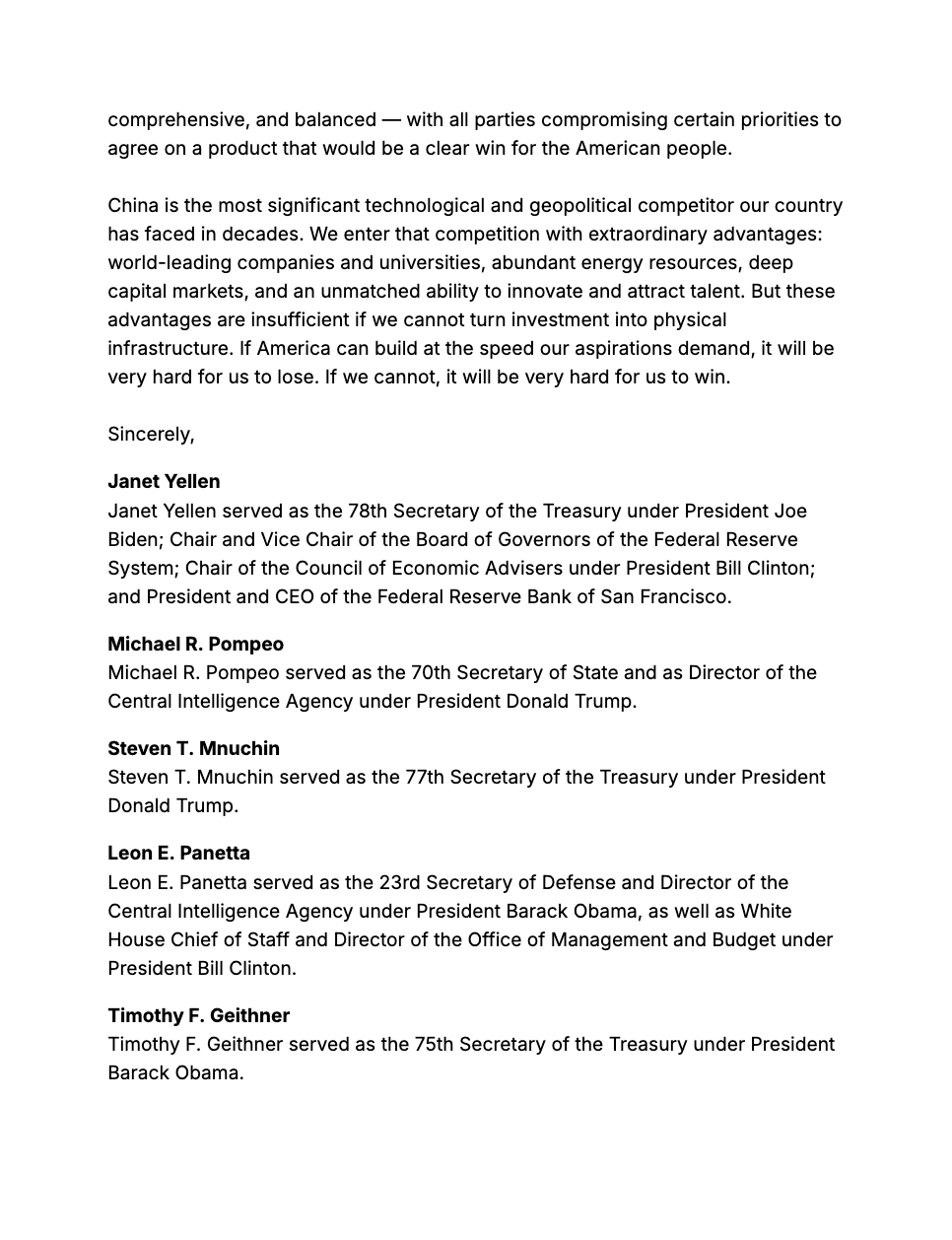
NEWS: 19 FORMER ECONOMIC AND NATIONAL SECURITY LEADERS ENDORSE THE BIPARTISAN PERMITTING REFORM BILL
Today, a group of former Cabinet members and White House principals across seven Democratic and Republican administrations sent a letter calling on Congress to pass BAAJA. Here anet YELLEN, Michael R. POMPEO, Steven T. MNUCHIN, Leon E. PANETTA, Timothy F. GEITHNER, Henry M. PAULSON, Jr., Robert E. RUBIN, Stephen MIRAN, Jared BERNSTEIN, Tyler GOODSPEED, Jason FURMAN, Glenn HUBBARD, Laura D’Andrea TYSON, Michael J. BOSKIN, Jeffrey ZIENTS, Jake SULLIVAN, Brian DEESE, Larry KUDLOW, Allan B. HUBBARD
Key highlights from the letter:
1. “We are not building infrastructure fast enough to remain globally competitive… The median time for a new power plant to move from an interconnection request to commercial operation has more than doubled, from less than two years for projects built between 2000 and 2007 to more than four years for projects built between 2018 and 2024.
2. China has built more high-voltage transmission in the last fifteen years than the U.S. has built in all of its history... In 2024, China accounted for 31.5% of global knowledge- and technology-intensive manufacturing value added, compared with 20.7% for the United States.
3. Federally funded or permitted projects require NEPA review, but private projects often do not, creating a threat of failure precisely where the government is trying to be proactive, strategic, and engaged.
4. A project that spends years awaiting approval must continue carrying development and financing costs while remaining exposed to rising input costs. The IEA reports that prices for utility-scale transformers increased 26% in 2024, while lead times for some transformers have stretched as long as six years.
5. Mining projects also face tremendous uncertainty: a 2026 study by researchers at the Colorado School of Mines found that permitting for modern mining projects takes an average of 5.5 years, rising to 8.9 years for contested projects. The U.S. currently has the second-longest mine development timeline in the world.
6. The Bipartisan American Affordability and Jobs Act is the most significant bipartisan legislative effort that Congress has undertaken in decades to tackle these challenges.
7. BAAJA addresses key constraints stifling American industry by requiring interregional transmission planning, strengthening the federal backstop for nationally significant transmission lines, and creating a faster, more predictable process for connecting new generation to the grid.
8. BAAJA also makes permits more durable by imposing tighter timelines for litigation and limiting frivolous lawsuits that can halt projects indefinitely, while preserving community input and judicial review of substantive agency decisions.”
The letter was organized by @arnabdatta321 on behalf of @IFP and covered exclusively by the WSJ this morning.


19
112
423
146,357
Caleb Watney retweeted
OpenAI has pulled back from supporting AI chip controls, seemingly to appease Nvidia.
Bad for US AI dominance and national security simultaneously.
Grow a spine!
politico.com/news/2026/10/2…
Bad for US AI dominance and national security simultaneously.
Grow a spine!
politico.com/news/2026/10/2…

20
26
216
71,352
Caleb Watney retweeted

Peace, easy taxes, a tolerable administration of justice—and who could forget:
A large & highly competent administrative state capable of measuring & internalizing industrial externalities + of erecting (or planning the public-private erection) of massive public works
A large & highly competent administrative state capable of measuring & internalizing industrial externalities + of erecting (or planning the public-private erection) of massive public works
3
4
202
6,083
Caleb Watney retweeted

this is a crazy number when paired with: "restricting Chinese access to US AI chips is unlikely to reduce total US sales, as demand outside China is expected to outpace supply through at least the end of 2027."

By the end of next year, nearly a third of China's effective AI compute will come via remote access to American AI chips.
Using existing authorities, the US government could cut off this access immediately and widen our AI lead over China.
1
14
69
6,678
Caleb Watney retweeted
By the end of next year, nearly a third of China's effective AI compute will come via remote access to American AI chips.
Using existing authorities, the US government could cut off this access immediately and widen our AI lead over China.
Using existing authorities, the US government could cut off this access immediately and widen our AI lead over China.

Big new IFP report from @GeorgiaCAdamson, @KonstantinPilz, and me on the US-China AI competition.
We spent the last 6 months digging into how Chinese AI companies’ access to compute and distillation of American models translate into the current US-China capabilities gap.
The search report, including an interactive analytical model that visualizes changes in the US AI lead under different policy interventions.
Our findings:
1. The US AI lead over China is currently only around 6 months.
2. The US could roughly double this lead, to over a year, using authorities already available to the federal government.
3. On chips: China’s access to AI chips will roughly double over the next year, with chips housed in data centers overseas accounting for roughly half of China’s 2027 compute.
4. On distillation: the current ~16x US training compute advantage would normally yield a 13-month lead. But we estimate adversarial distillation halves this to around 6.5 months.
5. Increasing the lead would have some obvious benefits:
- Give the US broadly a greater cyberdefensive advantage against Chinese threat actors.
- Give US AI companies breathing room to spend more R&D resources on making their systems safer and more secure, without fear of being overtaken by less safety-conscious Chinese competitors.
6. Provide the US government more leverage in negotiations with China about the future of AI.
7. The two most important interventions are:
- For BIS: Create a new end-use control to restrict China’s remote access to training clusters abroad — China’s largest and fastest-growing source of frontier-scale compute.
- For DOJ/FTC: Create a narrow safe harbor to allow US companies to coordinate on countering Chinese adversarial distillation.
8. Both interventions (and all the others we discuss in the report) are things the federal government could do today.
9. To estimate the effects of each policy intervention, we model the US lead as a function of its compute advantage over China and China’s ability to adversarially distill the capabilities of the US frontier.
10. The model makes many simplifying assumptions, but provides a useful way to assess and rank the impact of different policy interventions at a high level.
Read the full report here: ifp.org/how-to-increas…
2
26
111
17,010
Caleb Watney retweeted
Big new IFP report from @GeorgiaCAdamson, @KonstantinPilz, and me on the US-China AI competition.
We spent the last 6 months digging into how Chinese AI companies’ access to compute and distillation of American models translate into the current US-China capabilities gap.
The search report, including an interactive analytical model that visualizes changes in the US AI lead under different policy interventions.
Our findings:
1. The US AI lead over China is currently only around 6 months.
2. The US could roughly double this lead, to over a year, using authorities already available to the federal government.
3. On chips: China’s access to AI chips will roughly double over the next year, with chips housed in data centers overseas accounting for roughly half of China’s 2027 compute.
4. On distillation: the current ~16x US training compute advantage would normally yield a 13-month lead. But we estimate adversarial distillation halves this to around 6.5 months.
5. Increasing the lead would have some obvious benefits:
- Give the US broadly a greater cyberdefensive advantage against Chinese threat actors.
- Give US AI companies breathing room to spend more R&D resources on making their systems safer and more secure, without fear of being overtaken by less safety-conscious Chinese competitors.
6. Provide the US government more leverage in negotiations with China about the future of AI.
7. The two most important interventions are:
- For BIS: Create a new end-use control to restrict China’s remote access to training clusters abroad — China’s largest and fastest-growing source of frontier-scale compute.
- For DOJ/FTC: Create a narrow safe harbor to allow US companies to coordinate on countering Chinese adversarial distillation.
8. Both interventions (and all the others we discuss in the report) are things the federal government could do today.
9. To estimate the effects of each policy intervention, we model the US lead as a function of its compute advantage over China and China’s ability to adversarially distill the capabilities of the US frontier.
10. The model makes many simplifying assumptions, but provides a useful way to assess and rank the impact of different policy interventions at a high level.
Read the full report here: ifp.org/how-to-increas…


30
106
365
98,503
Caleb Watney retweeted
Hard to think of a more regressive tax policy than “only people with mortgage debt should have to pay property taxes”
“I’m old. I’ve paid my home off,” said Ray Warner, a 72-year-old Akron resident. “Why would I pay property tax?”
Across the country, homeowners are asking the same question and revolting against property taxes at a scale not seen in a half century.
politico.com/news/magazine/…

57
249
5,388
79,023