
Julio Valls retweeted

update: the facial recognition code is used by samsung tv's and returns bounded boxes around faces.
code for facial recognition within the content was also found, investigating if this is used by their background services or if it's stock opencv code.
scans for bounding boxes in apps to track your usage can load new modules over time to expand coverage.
this is like 1 out of 50 things so far, and we're only just getting started.
48
355
4,631
113,454
Julio Valls retweeted

So basically, today PHP got two critical bugs that let anyone run code on your server without even logging in, which is bad, and then the details leaked before the patch was even out, which is worse, and it works on WordPress and MediaWiki and Magento and Joomla and Laravel, and Censys says like 1.5 million servers are running a version with no fix, so the NSA was like "take your system offline," and the FBI was like "take your system offline," and CISA and the UK and CERT-EU were all like "take your system offline," and then the Prime Minister of Japan, the actual Prime Minister, posted at 5:55 in the morning telling 48.8 million people to take their system offline, so everyone took their system offline, like the Dutch cybersecurity agency took its own website offline, and the Dutch parliament went offline, and the Port of Rotterdam went offline, and Finland and France and Denmark started pulling government sites, and Wikipedia went down, and Archive.org went down, and Asana and GOG and Something Awful went down, and the University of Vienna's webmail went down for some reason, and that's just PHP. Because GitLab also dropped a CVSS 10.0, which is the highest score they give out, for a bug that's been there since 2014, so that's every self-hosted GitLab for twelve years, and then LiteLLM 1.107.0 got hijacked and shipped a credential stealer and a remote access trojan in every single wheel and the Docker images, including latest, and you didn't even have to import it, just installing it was enough, and it's the second time this year, and then Railway paused every deployment on the entire platform because someone got into the environment variables, so now everyone has to rotate every secret they've ever stored there, and TiDB Cloud said someone was walking around inside with stolen credentials for basically a month and an extortion group says they took 10.6 terabytes, and Zeabur got breached for the second time in two months and is just shutting down, like the whole company, and Node.js patched remote code execution and a TLS bypass, and CISA says Plex is being actively exploited, and someone took over 300 Tor exit relays to steal SSH passwords, and SafePay ransomware has hit over 600 critical infrastructure orgs, and India's biggest bank filed a data loss incident, and Japan has been in an official state of emergency in cyberspace since October 9, which honestly explains the 5:55 AM post. Oh, and eMudhra, a certificate authority that's issued over 60 million certificates, whose entire job is proving websites are who they say they are, was supposed to be using private keys that are random numbers over a hundred digits long, and one of them was 4. Just 4. And the others were like 66 and 237. Anyway, it's Wednesday.
1,078
8,934
69,403
4,146,348
Julio Valls retweeted

-----BEGIN RSA PRIVATE KEY-----
4
-----END RSA PRIVATE KEY-----
4
-----END RSA PRIVATE KEY-----
249
3,999
42,370
1,089,945
Julio Valls retweeted

On my way to the office this morning, I passed a group of young people protesting, a Palestinian flag draped over their shoulders.
And I asked myself a question I can't shake: why does this generation always fall into the same trap? No matter the history. No matter the context. thy families, who went to the best schools, who were dealt every good card. Always the same trap.
I don't think it's stupidity. I think it's a mechanism. And a mechanism can be taken apart, piece by piece.
A. The observation: everything the state touches becomes unaffordable.
Look at economist Mark Perry's famous chart, the one people call "the chart of the century." It tracks US prices since 2000.
At the top, what explodes: hospital services, college tuition, textbooks, childcare, housing. Increases of +100%, +150%, up to +250%, far above general inflation.
At the bottom, what collapses: TVs, software, phones, toys, clothing. A TV today costs a fraction of what it did in 2000, for an infinitely better product.
Look at what separates the two groups. It isn't technology. It isn't complexity. It's one variable: how much the state is involved.
At the top, sectors that are subsidized, regulated, shielded from competition, where the state funds demand and blocks supply. At the bottom, sectors where companies fight every single morning to serve you better and cheaper.
B. The mechanism: why it's systematic.
When the state subsidizes demand without freeing supply, prices rise. Every time. Guaranteed student loans, and universities raise tuition. Housing aid plus blocked building permits, and rents skyrocket. Administered healthcare, and bureaucracy eats the budget before it ever reaches the patient.
In France it's even more vicious, because the price doesn't disappear: it hides. You never see the hospital bill, you pay it through payroll contributions. You never see the cost of school, you pay it through taxes. Public spending at 57% of GDP, one of the heaviest tax burdens in the world, more than €3.4 trillion in debt. And the result? Overflowing ERs, falling PISA scores, young people who can't afford to live in the city where they work.
The market didn't fail in these sectors. It was never allowed in.
C. Suffering demands a culprit.
A 22-year-old lives all of this in their bones. They can't find a place to live. Their degree either buries them in debt or opens no doors. The future feels blocked. That suffering is real, and I don't deny it for a second.
But human beings can't stand suffering without a culprit. They need a face. A scapegoat.
And this is where everything is decided: who taught them how to read the world?
D. Whoever tells the story picks the villain.
Schools are public. Universities are public. Culture runs on grants. Film goes through funding committees. Public broadcasting shapes the narratives. The people handing down the interpretive framework are, overwhelmingly, paid by the very system that creates the problem.
Do you really think that system is going to name itself as the culprit?
No. It names the capitalist. The boss. The landlord. "The rich." The multinational. The commercial West. Same role, same casting, every time.
E. One lens, a thousand causes.
And this brings me back to that flag. A generation taught to read every situation through a single lens, oppressor on one side, rich, Western, capitalist, oppressed on the other, will apply that lens everywhere. To housing. To climate. To conflicts on the other side of the world. The cause changes, the lens stays. That's why the trap is always the same: it's not the cause that draws them in, it's the way of thinking that was installed in them.
F. The perfect inversion.
Here's the irony. Capitalism is the force that drove down the price of almost everything it touched. The state is the force that blew up the price of almost everything it captured. And young people blame the first for the crimes of the second.
It's like blaming the firefighter for the fire because you saw him at the scene.
G. The ballot box confirms it.
In the US, a few weeks out from the midterms, a large share of urban young voters is getting ready to vote Democrat for more state, more spending, more regulation. New York elected a self-described socialist mayor, carried by young voters, on promises of rent freezes and city-run grocery stores. Rent freezes, the policy that has made housing scarcer everywhere it's been tried. The cure that worsens the disease.
In France, it's the same play in two acts. Part of the youth votes for the radical left, which promises more state. Another part votes for the center, which promises to "manage" the state well, and has dug the debt deeper than ever. Two different ballots, one shared assumption: the problem is the market, the solution is the state.
H. The way out.
These young people aren't stupid. They're right to be angry. They're just aiming at the wrong target.
The day they understand that their rent, their tuition and their hospital are expensive precisely because the state runs them, their anger will change direction. They'll stop protesting against those who create. They'll start protesting against those who capture.
That day, the greatest intellectual scam of our time will be over.

709
4,404
16,594
1,806,217
Julio Valls retweeted

We placed the fruit fly brain inside Odyssey-3, a frontier world model.
The lil’ guy is now flying around totally imagined, simulated worlds all by itself 🫶
The lil’ guy is now flying around totally imagined, simulated worlds all by itself 🫶
673
1,788
20,442
6,244,147
Julio Valls retweeted

🚀 DeepSeek-V4.1-Flash-1017 is here!
Stronger benchmark performance, faster task completion, and shorter outputs than the previous version—a Pareto improvement in performance and cost. Now live on our website, app, and API.
🛠️ Optimized for @DeepSeekHarness, Tencent CodeBuddy, grade to DeepSeek Harness v0.2.1-rc.1 or later for the best experience with the new model.
1/4


1,622
4,128
37,125
8,011,078
Julio Valls retweeted

En 8 años nos hemos convertido en una república bananera.
77
1,032
3,721
105,215


Hey @claudeai is the cli login flow broken for anyone else or just me?
0
0
0
10
Julio Valls retweeted

Veamos cómo va esto dos semanas después:
Madrid: 10.335 (-12,21%)
Málaga: 9.550 (-4,98%)
Valencia: 4.825 (-11,48%)
Barcelona: 3.428 (-9,60%)
Sevilla: 2.068 (-15,28%)
Vizcaya: 540 (-14,29%)
Zaragoza: 544 (-9,78%)
Un éxito rotundo los Decretazos para el alquiler.
Madrid: 10.335 (-12,21%)
Málaga: 9.550 (-4,98%)
Valencia: 4.825 (-11,48%)
Barcelona: 3.428 (-9,60%)
Sevilla: 2.068 (-15,28%)
Vizcaya: 540 (-14,29%)
Zaragoza: 544 (-9,78%)
Un éxito rotundo los Decretazos para el alquiler.


En estos momentos Idealista tiene los siguientes anuncios de alquiler por provincia:
Madrid: 11.772
Málaga: 10.050
Valencia: 5.450
Barcelona: 3.792
Sevilla: 2.441
Vizcaya: 630
Zaragoza: 603
Guardad el tuit y en un par de semanas comparamos.


34
474
1,027
36,749
Julio Valls retweeted

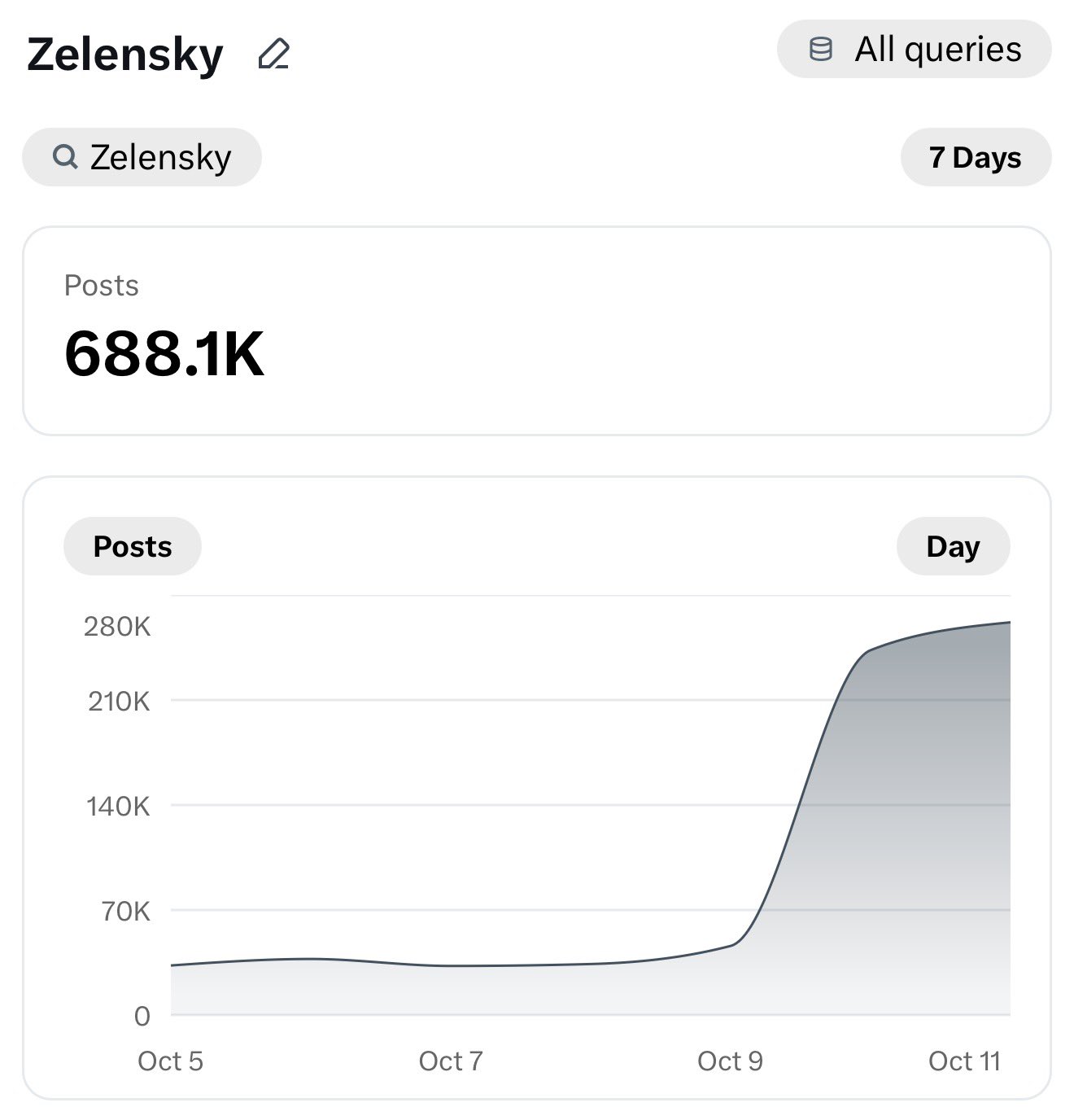
Funny thing: Ukraine takes out Russian data centers and “Zelensky” rises while “genocide” and “Free Palestine” drops off according to X’s Radar analytics page.
Anyone else seeing trends w/🇷🇺 bots muzzled?
Anyone else seeing trends w/🇷🇺 bots muzzled?


300
2,134
11,226
1,021,704


Julio Valls retweeted

I've vibe coded replacements to 7 of Adobe's apps in Rust. They're open source (links below)

123
182
1,265
67,259
Julio Valls retweeted

Huelga general, contra la oposición, motivada por una señora que alquiló con Franco y fue desahuciada por una ley de Felipe González durante el gobierno de Sánchez.
Un día más en este manicomio.
Un día más en este manicomio.
🔴 ÚLTIMA HORA | Los sindicatos UGT y CC OO irán a la huelga general por la crisis de la vivienda social.elpais.com/bth0r

43
2,631
10,152
158,129
Julio Valls retweeted

La crisis de vivienda en España: lo que creo que puede funcionar para solucionarla... y lo que probablemente no sirva o sea directamente contraproducente. En siete minutos y medio.
Dentro video 👇
Dentro video 👇
719
8,935
21,964
2,057,506
Julio Valls retweeted

Young second and third-generation migrants film a French firefighter after setting him on fire during the school protests in Bordeaux
🇫🇷
🇫🇷

3,757
15,057
73,544
7,082,895
Julio Valls retweeted

Esta imagen refleja muy bien el mundo moderno.
Cómo los medios y los políticos inflan una burbuja que muchas veces poco tiene que ver con la realidad.
Esta vez, por muy poco, la burbuja ha estado a punto de explotarnos en la cara.
Cómo los medios y los políticos inflan una burbuja que muchas veces poco tiene que ver con la realidad.
Esta vez, por muy poco, la burbuja ha estado a punto de explotarnos en la cara.

117
2,059
5,934
166,567
Julio Valls retweeted

Someone rewrote Kafka in Rust and embedded it in Postgres using pgrx 🤯
Kafgres is a Rust-based Kafka broker that runs within Postgres. Kafka clients connect to Postgres on port 9092 and literally can't tell the difference. 🧵
Kafgres is a Rust-based Kafka broker that runs within Postgres. Kafka clients connect to Postgres on port 9092 and literally can't tell the difference. 🧵

56
171
1,774
132,559
