


urchade retweeted

Competition is good for everyone.
It took thousands of use cases and a lot of work by the @fastinoAI research team, great to see the results.
Also proud to release the weights to GLiDE to @huggingface so anyone can train their own SOTA decision / system one / classification models.
It took thousands of use cases and a lot of work by the @fastinoAI research team, great to see the results.
Also proud to release the weights to GLiDE to @huggingface so anyone can train their own SOTA decision / system one / classification models.
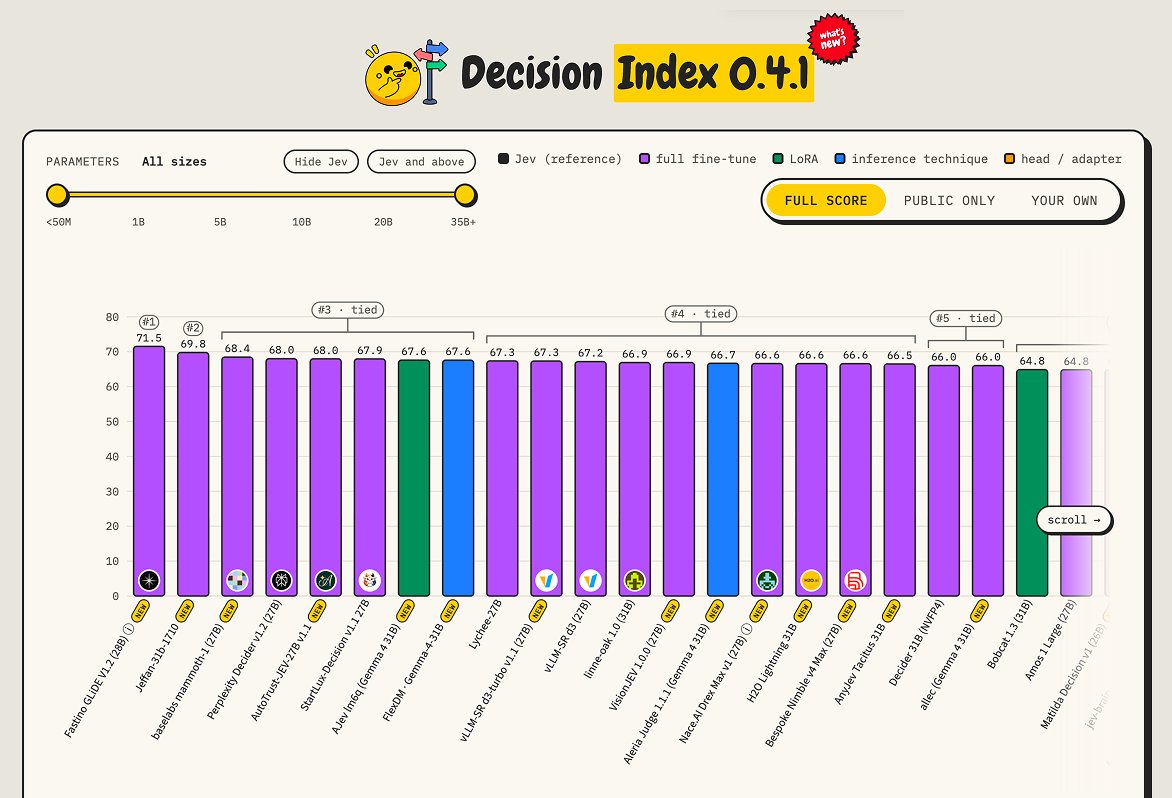
just updated the Decision Index to 0.4 🧭
what's new?
🛡️ curbing benchmaxxing: score now exclusively made from private & in-house benchmarks
🔒 stronger private benchmarks on new domains
🏆 224 models evaluated, new top models in all sizes
come play 👉huggingface.co/spaces/multimo…

0
4
9
433
urchade retweeted

Have you ever wondered “How do the top labs train a Frontier Model?”
Read this technical report I wrote on how we trained the Best Decision Model in the world (according to Hugging Face’s official rigorous rankings). fastino.ai/blog/training-…
Keep in mind, that we did it with a es that the other brilliant frontier labs on the leaderboard have. They have made incredible models and deserve applause as well.
Official Jev Decision Index leaderboard: huggingface.co/spaces/multimo…

1
6
31
5,297
urchade retweeted

Our newest decision model is the world's best decision model.
Introducing GLiDE v1.2, the #1 model on the @huggingface Decision Index.
With an overall score of 71.5, GLiDE v1.2 also has one of the lowest calibration errors on the entire Decision Index, meaning its confidence ow often its answers are correct.
Beyond improved benchmark performance, it also adds support for multimodal inputs, enabling decision-making using text, JSON, and images.
We are excited to release the model weights on Hugging Face. For hosted inference, you can also run GLiDE v1.2 through the Fastino API at $0.04 / million input tokens.
Use promo code GLIDEIS1 for $10 in API credits.
Model weights: huggingface.co/fastino/GLiDE
API: agent.fastino.ai
Blog: fastino.ai/blog/training-…
11
26
151
15,372
urchade retweeted
The best decision model in the world. GLiDE v1.2 is here (and it’s multimodal).
#1 on the @huggingface Decision Index, beating the next best model by 1.7 points.
The benchmarks are genuinely impressive:
- 71.5 full score
- 82 ms latency on NVIDIA RTX PRO 6000
- 1.9% ld-out decisions (one of the lowest on the index)
This model is smart, fast, well-calibrated, and open weight. Everything a good decision model should be. We’ve also dropped our pricing to $0.04 / million input tokens.
Try it today. Use promo code GLIDEIS1 for $10 in API credits.
API: agent.fastino.ai
Weights: huggingface.co/fastino/GLiDE

3
12
57
85,076
just updated the Decision Index to 0.4 🧭
what's new?
🛡️ curbing benchmaxxing: score now exclusively made from private & in-house benchmarks
🔒 stronger private benchmarks on new domains
🏆 224 models evaluated, new top models in all sizes
come play 👉huggingface.co/spaces/multimo…
1
0
8
222
urchade retweeted
just updated the Decision Index to 0.4 🧭
what's new?
🛡️ curbing benchmaxxing: score now exclusively made from private & in-house benchmarks
🔒 stronger private benchmarks on new domains
🏆 224 models evaluated, new top models in all sizes
come play 👉huggingface.co/spaces/multimo…
what's new?
🛡️ curbing benchmaxxing: score now exclusively made from private & in-house benchmarks
🔒 stronger private benchmarks on new domains
🏆 224 models evaluated, new top models in all sizes
come play 👉huggingface.co/spaces/multimo…
16
9
53
12,752
urchade retweeted
Open source models thrive when they’re built with feedback from the community.
Sharing model weights and code allows developers to build on existing work, contribute improvements, and help the models evolve over time.
In our latest video, founding researcher, @urchadeDS, shares has helped shape GLiNER into what it is today.
This week, we’re celebrating Open Source AI Week with the rest of the community in San Francisco. Open source has always been an important part of our work at Fastino, and it continues to play a major role in how and why we build.
Watch the full conversation between @george_onx and Urchade: youtu.be/6t6pZXsQXas
0
4
11
516
urchade retweeted
You can now post-train Qwen3.6-35B-A3B with the Fastino Training API. Here are 3 ideas for what you can build:
Decision model → FT on context-plus-options pairs labeled with the correct choice. RL rewards picking the right option with well-calibrated confidence in a single short answer.
Text-to-SQL analyst → SFT on question-to-query pairs for a specific database schema. RL runs each query and rewards an exact match with the correct result set.
Fast reasoner that thinks less → SFT on concise reasoning traces for math or code. RL rewards correct answers minus a penalty for thinking tokens, so it gets cheaper while maintaining accuracy.
Training API: agent.fastino.ai
The Fastino Training API now supports Qwen3.6-35B-A3B for training and inference.
It’s strong at coding and reasoning, with tool calling to plan and execute multi-step agentic workflows, making it a great foundation for production AI that needs to make decisions and take action.
imodal, supporting text, image, and video inputs.
Start training: agent.fastino.ai

1
5
22
827
urchade retweeted
6 lessons from fine-tuning @NVIDIAAI Nemotron 3.5 Super VL across finance, healthcare and math:
1. Teach the interface; Super already has the knowledge
-Largest gains from learning exact programs, spans + output fields
-Small amounts of format-specific data made a huge e artifact, not explanatory prose
2. A few hundred correctly labeled examples go a long way
-500 examples produced a 42-point accuracy gain
-Only 15 minutes of training
-Correctness + consistent formatting mattered more than volume
3. Mix skills to protect neighboring tasks
-Narrow tuning pulled related tasks toward the wrong output format
-More single-skill data made the interference worse
-A balanced mixture preserved multiple behaviors
4. Recipes transferred to Nemotron Super
-Data + hyperparameters developed on Nemotron 3.5 Lightning reused unchanged
-Transfer held across every task measured
-Recipe search on the smaller model, then one run on Super
5. Fine-tuning teaches length, not just content
-One task went from 1,597 → 113 output tokens
-Accuracy still increased by 8.4 points
-Math RL produced 25% shorter answers + ~6 points higher accuracy
6. Use 1x to 2x the full-adapter learning rate, and give the model room to think
-2x LR produced larger healthcare gains on 7 of 8 evaluations
-Higher token limits prevented strong answers from being cut off
-At 1,024 tokens, 39% of base math responses were truncated
For more on benchmarks and training recipes see our latest blog.
Blog: fastino.ai/blog/nvidia-ne…

5
3
13
491
urchade retweeted
@NVIDIAAI and we go together like peanut butter and jelly. 😋 Incredible work from the genius @DhruvAtreja1 👏👏🔥🔥
We collaborated with @NVIDIAAI on early access post-training. Spoiler alert: It's an incredible model to train!
Technical blog: fastino.ai/blog/nvidia-ne…

1
2
5
192
urchade retweeted
Today we’re launching the Fastino Training API for supervised fine-tuning and reinforcement learning.
The Fastino Training API includes day-zero support for @NVIDIAAI Nemotron 3.5 Super VL, alongside Nemotron 3.5 Lightning.
Our API gives ML and research teams low-level control out requiring them to provision GPUs or operate separate training and generation systems.
A few highlights:
• Write your own SFT and RL loops in Python
• Train with importance sampling, PPO, CISPO, or DRO
• Run grouped sampling with token log probabilities
• Save and resume adapter and optimizer checkpoints
• Pay per token processed, not per GPU hour
• Spend 25% to 85% less than Tinker’s published rates
• Migrate existing Tinker workloads by changing only the server address and API key
Along with the Training API, we’re releasing two start-of-the-art open weight models fine-tuned on NVIDIA Nemotron 3.5 Super VL, specialized for finance and healthcare. Together, they improved performance across all 15 held-out benchmarks we measured.
And for a limited time, we’re offering discounted pricing on training for NVIDIA Nemotron 3.5 Super VL through the Fastino Training API.
Try it now: agent.fastino.ai

7
12
44
2,911
urchade retweeted
We just launched the cheapest training API in the world, and all the routes are tinker compatible!
Today we’re launching the Fastino Training API for supervised fine-tuning and reinforcement learning.
The Fastino Training API includes day-zero support for @NVIDIAAI Nemotron 3.5 Super VL, alongside Nemotron 3.5 Lightning.
Our API gives ML and research teams low-level control out requiring them to provision GPUs or operate separate training and generation systems.
A few highlights:
• Write your own SFT and RL loops in Python
• Train with importance sampling, PPO, CISPO, or DRO
• Run grouped sampling with token log probabilities
• Save and resume adapter and optimizer checkpoints
• Pay per token processed, not per GPU hour
• Spend 25% to 85% less than Tinker’s published rates
• Migrate existing Tinker workloads by changing only the server address and API key
Along with the Training API, we’re releasing two start-of-the-art open weight models fine-tuned on NVIDIA Nemotron 3.5 Super VL, specialized for finance and healthcare. Together, they improved performance across all 15 held-out benchmarks we measured.
And for a limited time, we’re offering discounted pricing on training for NVIDIA Nemotron 3.5 Super VL through the Fastino Training API.
Try it now: agent.fastino.ai
3
2
12
1,029
urchade retweeted
We collaborated with @NVIDIAAI on early access post-training. Spoiler alert: It's an incredible model to train!
Technical blog: fastino.ai/blog/nvidia-ne…
Technical blog: fastino.ai/blog/nvidia-ne…

Meet NVIDIA Nemotron 3.5 Super VL
Our new open model combines reasoning and tool use with text, image, document, and video understanding for long-running AI agents.
120B total parameters with 12B active 🧵

3
3
22
1,433
urchade retweeted
Best Nemotron model I've used on agentic multi-turn tasks. Our team at @fastinoAI had early access to the weights and this one is plugged into a few of my agents. Awesome work guys 👏 @NVIDIAAI
Meet NVIDIA Nemotron 3.5 Super VL
Our new open model combines reasoning and tool use with text, image, document, and video understanding for long-running AI agents.
120B total parameters with 12B active 🧵
2
4
25
2,248
urchade retweeted
Today we’re launching the Fastino Training API, a low-level post-training API for running SFT and RL loops on hosted GPUs, along with day-zero support for @NVIDIAAI Nemotron 3.5 Super VL.
The API gives users control over the training loop, data, rewards, and evaluations, while ture for model execution, sampling, gradient computation, weight updates, and checkpoints.
The Fastino Training API is fully compatible with the Tinker SDK and cookbook, so teams can run existing SFT and RL workflows on it without rewriting their training loops.
Switching over from Tinker can reduce post-training costs by 25% to 85%, and setup is easy. Just swap the server address and API key in your environment, and your training and sampling clients, model configurations, and tooling stay the same.
In addition to day-zero support for Nemotron 3.5 Super VL, the Fastino Training API supports training for Nemotron 3.5 Lightning.
To celebrate the launch of the model, we’re offering a limited-time discount on training for Nemotron 3.5 Super VL on the Fastino Training API.
We’re also releasing two open weight specialized models fine-tuned from NVIDIA Nemotron 3.5 Super VL using the Fastino API, one for finance and one for healthcare. Both models showed improved performance across all 15 benchmarks we measured.
Start training: agent.fastino.ai
Read the launch blog: fastino.ai/blog/fastino-t…

5
7
35
2,046
urchade retweeted
Artificial Analysis officially ranked GLiDE as the # 2 Decision Model in the WORLD 🤯🤯🤯
Trained a SOTA foundational model that is # 2 in the world according to the holy grail benchmark, Artificial Analysis. Lifetime personal bucket list item ✅
What a life 🤯
Trained a SOTA foundational model that is # 2 in the world according to the holy grail benchmark, Artificial Analysis. Lifetime personal bucket list item ✅
What a life 🤯

1
2
31
2,106
urchade retweeted
Great to see GLiDE at #2, and we have a huge update coming out this week
Seeing the model perform this well on a completely independent evaluation shows just how strong the model is
Is seems adaptive thinking is a big reason why:
-GLiDE first calculates a fast probability distribution -If the leading answer is uncertain, reasoning turns on -That reasoning is incorporated into the final probabilities
Easy decisions stay fast, harder decisions get extra compute. This is especially useful for knowledge, reasoning and complex tool routing, where most decision models fail
We will be releasing the weights and a full rundown on how we trained the model with our training api
Try it through the Fastino API with code USE_GLIDE for free credits.
Introducing the Artificial Analysis Decision Index, benchmarking decision models across classification, tool calling, knowledge and reasoning. Jev leads among decision models; language models such as Claude Haiku 5.5 still deliver higher accuracy, but at much higher cost and s deliver structured answers or classifications with associated probabilities, offering faster responses and lower costs than using language models. The Artificial Analysis Decision Index v1.0 compares the capability, cost, and speed of decision models and also compares to language models.
Benchmarks in the Artificial Analysis Decision Index v1.0:
➤ AA-Omniscience-Decision: A private dataset of 500 questions adapted from the proprietary AA-Omniscience benchmark, measuring decision models’ knowledge and tendency to hallucinate
➤ HLE-MultiChoice: 513 text-only multiple-choice questions from Humanity’s Last Exam, testing decision models’ reasoning capabilities
➤ When2Call: A tool-calling benchmark from NVIDIA, testing whether models can correctly decide to call a tool, request clarification, decline to answer, or respond directly, evaluating capabilities relevant to agentic workflows and tool routing
➤ WildGuardTest: A safety benchmark evaluating models’ classification capabilities across harmful user requests, assistant refusals, and harmful responses. We use a subset of 835 of the original 1,725 test rows where all three human annotators agreed on all three labels, after excluding questions that consistently trigger model refusals
Key results:
➤ Jev 1.13 leads the Decision Index, and sits on the Capability vs. Cost Pareto frontier: Jev 1.13 from @typesafeai scores 58 on the Artificial Analysis Decision Index, ahead of GLiDE (54) from @fastinoAI and Microsoft-Decision-1 (54) from @Microsoft. Decider v1.1 27B from @perplexity_ai has the lowest Cost per 1M Tasks at $17, with Microsoft-Decision-1 ($31) and Jev 1.13 ($42) also on the Capability vs. Cost Pareto frontier. Celeris-1 Decision has the fastest Time per Task at 0.06 seconds, more than 2x faster than Jev 1.13 (0.13 seconds per task)
➤ Decision models are poorly calibrated on knowledge and reasoning tasks: Across almost all probability levels for chosen answers, accuracy falls below that probability for all decision models. This gap is largest on AA-Omniscience-Decision and HLE-MultiChoice, while most models are relatively well-calibrated on WildGuardTest (classification) and When2Call (tool calling)
➤ Decision models offer significant speed and cost advantages over language models, but trail on knowledge and reasoning: On classification and tool-calling tasks, leading decision models perform comparably to language models while being significantly faster and cheaper. However, language models substantially outperform on knowledge and reasoning. Claude Haiku 5.5 (Low) scores 61 on the Decision Index, 3 points ahead of Jev 1.13, but takes 1.4 seconds per task vs. 0.13 seconds (11x slower) and costs $184 per 1M Tasks vs. $42 for Jev 1.13 (4.4x more expensive)
We will continue to develop the Artificial Analysis Decision Index to help developers and companies better understand when and how to use decision models.


3
5
21
1,163
urchade retweeted

I paired Jev and GLiNER with an LLM coaches to play Doom:
- GLiNER makes split-second calls, and the LLM sets the strategy ("go get a plasma rifle")
- GLiNER gained far more from LLM coaching than Jev. Massively outperforming solo-Jev, Jev+LLM, and solo-GLiNER
- GLiNER makes split-second calls, and the LLM sets the strategy ("go get a plasma rifle")
- GLiNER gained far more from LLM coaching than Jev. Massively outperforming solo-Jev, Jev+LLM, and solo-GLiNER
1
1
3
186
urchade retweeted

Everyone is talking about specialized models today, so perfect timing to show this! I gave the Fastino Agent one goal: teach GLiNER Decide to play Mario. It built data, fine-tuned via our API, analyzed failures, and ran each new experiment autonomously. The before/after is wild
2
4
6
308
urchade retweeted
Next week, we’re headed to Berlin for @NVIDIAGTC.
We’re excited to connect with the community, explore the latest developments in AI, and share what we’ve been building.
If you’re attending and want to chat, schedule a meeting with our team here: calendly.com/d/d32c-tcj-b73…
We’re excited to connect with the community, explore the latest developments in AI, and share what we’ve been building.
If you’re attending and want to chat, schedule a meeting with our team here: calendly.com/d/d32c-tcj-b73…

0
3
6
352