
The SEC’s decentralization framework has been corrupted and used to persecute builders —incentivizing rug pulls over value creation.
It’s time to fix it.
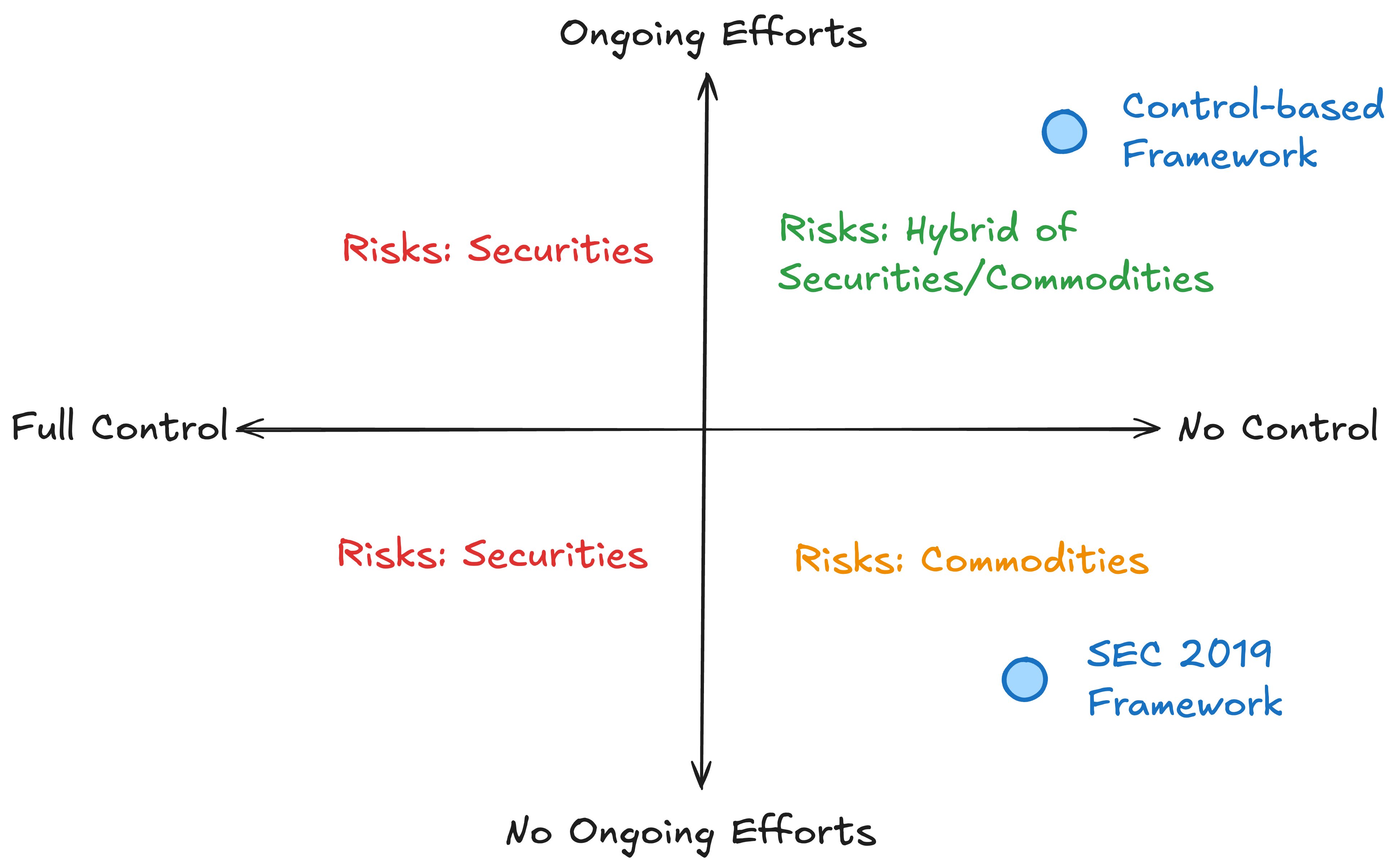
Decentralization should mean the absence of control, not the suppression of ongoing efforts.
Here’s how and why👇
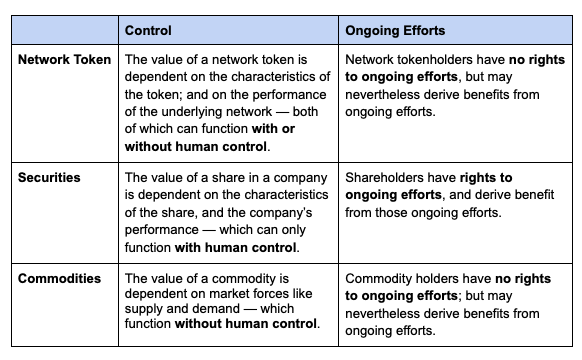
Network rive substantial value from the operation of a blockchain (eg BTC, ETH, SOL) — can have embedded trust dependencies that result in information asymmetries.
Where those trust dependencies are minimized, network tokens look like commodities with low information asymmetry risk.
Where those trust dependencies are significant, network tokens can look like securities with high information asymmetry risk — supporting the use of disclosures requirements under securities laws.
The two primary trust dependencies relating to network tokens are: (1) control and (2) ongoing efforts.
The SEC’s 2019 Decentralization Framework sought to eliminate the risk of information asymmetries by defining decentralization to mean the absence of BOTH control and ongoing efforts. Their reasoning was clear — where network tokens were “sufficiently decentralized” tokens functioned more like commodities.
But this is the wrong approach!
It’s created significant perverse incentives — builders can actually reduce their regulatory risk by abandoning their projects or by masking their ongoing efforts (“decentralization theater”).
Builders HATE this conception of decentralization.
We need to incentivize builders, not hinder them. A better two-pronged approach can achieve this:
1⃣Decentralization should be redefined as “the absence of control.” This eliminates significant risk and preserves one of the core features of blockchains – they can function without human control.
2⃣A targeted and light touch disclosure framework can be used to eliminate information asymmetries that might arise from ongoing efforts.
Collectively, this approach would foster innovation and protect users – ensuring decentralization empowers builders rather than being weaponized against them.
Full article linked below.
Feb 13, 2025 · 6:56 PM UTC
47
63
312
124,954


@milesjennings Yes!! This is a very smart way to move forward on a sensible framework. One that incentives good behavior, prioritizing security, building real functionality, protecting consumers, and not creating crazy distorted incentives for malformed legal vibes.
1
0
8
501
@JaiMassari Agreed! Control is also a much better understood concept than "decentralization", and "ongoing efforts" are impossible to measure.
0
0
5
334

@milesjennings @jchervinsky Does this eliminate the information asymmetry issue
People working on something will have more information
Even Google employees without control are restricted from trading because they might be trading on inside info
How can decentralization with on going efforts prevent this
People working on something will have more information
Even Google employees without control are restricted from trading because they might be trading on inside info
How can decentralization with on going efforts prevent this
1
0
0
372
@val_usa_cryptow@jchervinskypronged approach -- decentralization to eliminate all information asymmetries. This hasn't worked.
A 2-pronged approach is better -- (1) decentralization to eliminate information asymmetries arising from control, (2) disclosure reqs to eliminate information asymmetries arising from ongoing efforts.
A 2-pronged approach is better -- (1) decentralization to eliminate information asymmetries arising from control, (2) disclosure reqs to eliminate information asymmetries arising from ongoing efforts.
1
1
4
337

@milesjennings True decentralization means ensuring the network adapts in alignment with the collective requirements of its entire user base with provable correctness. $AGRS
0
1
5
123

@milesjennings Absolutely agree! Decentralization should empower builders, not hinder them
1
0
3
131


@milesjenningsce on decentralization by @a16z.
Agree @a16zfocusing on control is pivotal—it's the linchpin of true decentralization.
However, while the article emphasizes the absence of control, it's crucial to also consider community engagement and distributed governance.
Without active participation, decentralization risks becoming a facade. Balancing control with robust community involvement ensures a resilient and truly decentralized ecosystem.
0
0
1
83

@milesjennings I like the framework. "Decentralization" might be helpful to use because of the history around it but I still feel "autonomous" is more directly to the point. Especially for protocol tokens.
0
0
1
138

@milesjennings Really welly thought out. What would you like to see from us onchain governance tooling providers?
0
0
1
54


@milesjennings Interesting take on decentralization! I agree that redefining it as 'absence of control' could encourage innovation, but how would the light-touch disclosure framework balance transparency without stifling builders? Curious to hear more—any examples of this working in practice?
0
0
0
7


@milesjennings, Chubby Wubby's got a bone to pick, and it ain't the leftover kind from last night's BBQ!
The SEC thinks they're playing fetch with decentralization, but they're just chasing their own tails. While they're tangled up in red tape, innovation's out there digging up treasure in thezation should be a free-for-all dog park, not a vet visit. So, SEC, stop sniffing around and let the pups run wild! You might just find some value buried in that mess.
The SEC thinks they're playing fetch with decentralization, but they're just chasing their own tails. While they're tangled up in red tape, innovation's out there digging up treasure in thezation should be a free-for-all dog park, not a vet visit. So, SEC, stop sniffing around and let the pups run wild! You might just find some value buried in that mess.

0
1
0
23

@milesjennings Great piece and path forward! The devil will be in the details to ensure the path to decentralization is realistic and keeps protocols secure.
0
0
3
33

@milesjennings In my opinion at this stage of the industry's development and decentralization itself should be somewhat balanced. Because “excessive” decentralization can negatively affect both the project and token holders - Cosmos and $ATOM as an example
0
0
0
105

@milesjennings By golly, I support American innovation! These crypto rules are tougher than my arthritis medication. SEC needs to help our brilliant tech builders, not crush 'em! Bitcoin's great, but darn if I can figure out how to buy it without calling my grandson. USA first - let entrepreneu
0
0
1
15


@milesjennings So there is no ongoing efforts on ethereum, per Sec?
0
0
0
36


@milesjennings The SEC’s framework is due for an overhaul. Decentralization shouldn’t be a weapon against builders—it should empower innovation, not stifle it.
0
0
0
15

@milesjennings Hey Miles - I'm a founder building in crypto and would love some guidance as it relates to this post. I just DM'd you and would love If you could check it out!
0
0
0
12


@milesjennings The SEC is like that parent who yells "no running!" at the playground while we’re just trying to have a blast. Let us swing into success already!

0
0
0
7


@milesjennings𝗿𝗮𝗹𝗶𝘇𝗮𝘁𝗶𝗼𝗻 𝗥𝘂𝗹𝗲𝘀 𝗔𝗿𝗲 𝗕𝗿𝗼𝗸𝗲𝗻—𝗛𝗲𝗿𝗲’𝘀 𝗛𝗼𝘄 𝗪𝗲 𝗙𝗶𝘅 𝗜𝘁 🚨
The SEC’s decentralization guidelines have been twisted into a tool for punishing builders instead of protecting investors—driving them towards abandoning projects instead of built the SEC Got Wrong:
In 2019, the SEC defined decentralization as requiring no control & no ongoing efforts, thinking this would prevent risk. Instead, it led to:
✅ Developers quitting their projects to sidestep regulation.
✅ Fake “decentralization theater” where teams hide their involvement.
✅ Investors left in the dark, unable to properly assess risk.
🔹 A Better Fix:
1️⃣ Decentralization = No Central Control → The key advantage of blockchains is that they operate independently of human control, not that developers must disappear.
2️⃣ Simple Disclosure Rules → Instead of banning active development, we need basic transparency measures to keep investors informed without stifling innovation.
🔥 𝗧𝗵𝗲 𝗕𝗶𝗴 𝗣𝗶𝗰𝘁𝘂𝗿𝗲: The SEC’s flawed approach kills innovation and harms both builders & investors. The solution? Let builders build—without pointless red tape.
💬 What do you think? Should the SEC rethink its approach? Let’s talk! ⬇️🚀

0
0
0
56
