

in 3 days I'll be presenting Bend on the Lean Meetup, SF
bring your hardest questions!
link in the comments below ↓
bring your hardest questions!
link in the comments below ↓

44
51
1,454
(off-topic)
With AGI is coming, can we start talking about how it can actually improve our pathetic carbon-based lives?
One of the scariest things in life is the fact you can randomly have a stroke and become incapable. I've seen that happen to people I love, to streamers, to mmon, it is devastating, and it is one of the things I feel like humanity got wrong.
These days, I've been wondering whether there could be a way to greatly reduce your odds of going through this.
(From now below, please read this post as speculative science fiction written by a complete layman.)
I'm not talking about preventive measures, like controlling your pressure, eating well, or exercising. These are very effective, but they max out. Strokes can and do happen, even with perfect prevention and health. So, I'm talking about something stronger: an hypothetical first-aid treatment that would shut down a stroke at home; i.e., something like the Heimlich Maneuver, but for CVAs.
Let's imagine an hypothetically perfect intervention.
A clog is formed somewhere, it travels through your blood stream, and clogs an artery supplying blood to your brain. A side of your face drops, you lose fine movement on one of your hands, and that arm feels heavily. You're having a stroke. From now on, every minute causes you to lose ~2 million neurons. These will never grow again, and the synaptic information they carry is lost forever. Your house is on fire, and every minute something is lost, except it is not your house, it is you. And you want to stop the fire, ASAP.
You tell your partner, who is prepared to act. They grab device X. Device X doesn't exist, and it may not be physically possible, so, it is science fiction. But it is the kind of device I believe might be plausibly constructive, specially post-AGI. What it does is simple: it scans you and outputs, with great accuracy, whether you're having a stroke, and what kind of stroke you're having. That's all. Your partner uses it on you, and you get a response:
"You're having an ischemic stroke. There is a small clot (~4 mm) blocking the M2 superior division of your left middle cerebral artery. No signs of hemorrhage. Estimated onset: 4 minutes ago. Brain tissue at risk: moderate, fully salvageable. Clot is small and fresh; high likelihood of dissolution with IV thrombolysis alone. Dial 911 immediatelly, and administer tenecteplase now: 0.25 mg/kg as a single intravenous bolus over 5 seconds (estimated weight 72 kg, dose 18 mg). Keep patient lying flat. Re-scan in 15 minutes."
Your partner administers the IV tenecteplase, and calls 911.
15 minutes later, the ambulance isn't here yet.
Luckily enough, your face looks normal.
You use Device X again.
It says:
"Left M2 artery reopened. Blood flow restored. No hemorrhage detected. Brain tissue at risk: none remaining. Contact emergency services for routine post-thrombolysis monitoring."
So, by just injecting tenecteplase fast enough, you escaped a whole life of misery and suffering. You almost became a vegetable. Instead, you just gained a scary memory. And you just needed 2 things: *information*, and an IV shot.
In a very practical sense, in the presence of perfect information, tenecteplase would be a "near antidote" for about half of all strokes (85% are ischemic, most of which are caused by small clots). The only reason we don't give tenecteplase at home today is that, sadly, if you're having an hemorrhagic stroke, then, it actually makes things worse, and the average outcomes even out. So, the information provided by Device X is what would allow this first-aid treatment to be effective.
I asked Opus 5.5 to evaluate this exact scenario. That is, you have a small clot ischemic stroke, device X confirms that's the case, and you administer tenecteplase on your way to the hospital. According to it, the odds of complete recovery are ~72%, against ~58% of not administering it. Note that this estimative could be completely off; we don't have enough data because tenecteplase is rarely given that quickly!
That said, if this estimate is correct, then, that means that this intervention would reduce the odds for an average person to be disabled by a stroke in their lifetimes from 14% to 11%. For a perspective, a perfectly healthy person has 4%. So, even such hypothetical device would still be less impactful than diet, exercise, sleep. Yet, it would do *something*, which is better than nothing. I for one would surely have such device at home, if it worked exactly like that.
Now, just to be clear, this post is just me fantasizing about simpler ways that AGI could improve our lives without necessarily curing cancer or something. Device X is sci-fi, but feels like the kind of thing that AGI could help us design: a portable, cheap scanner (perhaps some mix of microwave imaging, ultrasound, and EEG, paired with a very good model) that does at home what a CT scanner does in the ER today. CTs already exist, the drug already exists, the bottleneck is purely getting the *information* quickly enough, and that's the kind of problem that I believe AutoResearch could potentially solve. Or not.
Disclaimer: I'm not a doctor, and I have no idea what I'm talking about. For god's sake do not get ideas from this post. Tenecteplase will KILL you if you guess the wrong kind of stroke.

37
14
378


I think one of the things I under-explained about Bend's thesis is how it was designed to scale with AI, so let me talk about it because that's the most exciting thing that'll happen next.
My goal is that, very soon, Bend will start writing itself, with agents and laws, dented rate. The compiler will get faster every day, the ecosystem will grow larger everyday. And this will happen mostly autonomously, with us creating only laws. Bend 2.1 will be the first use-case of Bend used the Bend way.
We can't do it right *now*, obviously, because the V1 is written in TypeScript (which has no laws), but that's one of the reasons I kept the kernel tiny (~100k tokens): so I can put it all in a models context, ask for a full port to Bend, set up some laws, and then start evolving the compiler itself by autoresearch + laws.
We also want to grow a massive ecosystem that way. HOC will write well designed laws, and agents will fill the code.
One "small problem" we must address is how agents can write not just correct code, but FAST code. My plan is to have a formalized model of CUDA in Bend, so that agents can actually prove statements about the performance of the executables. That also doubles as a way to prove the correctness of the compiler (which is ugly & bug-ridden right now).
If this works, you can expect I'll be posting crazy updates at an insane rate. That should happen around December or so.
This is the next thing on my TODO list, I'll start doing it concurrently to the round (in SF, tomorrow!), and ramp up after that.

49
32
792
@AKAKenj1 youtube.com/watch?v=qVFIcF…
exatamente isso, é horrível e assustador
pra piorar hoje foi bem diferente a forma
exatamente isso, é horrível e assustador
pra piorar hoje foi bem diferente a forma
5
0
22

My harness: UniiChat.com
This is the closest to infinite context I've experienced.
I've been using it for a week to organize my life and build things (including itself!), and it just keeps going. I only use it now.
OSS next week, prompt to build your own below ↓
This is the closest to infinite context I've experienced.
I've been using it for a week to organize my life and build things (including itself!), and it just keeps going. I only use it now.
OSS next week, prompt to build your own below ↓
97
107
2,308

"do you literally type like that?"
yes, this is how I work now
I sit down, open ????Chat, type my stream of thoughts out for 30 minutes, press enter, and wait it get done
below I teach it about Bend's round, while it builds its own app
this is my life now
I miss VIM though
yes, this is how I work now
I sit down, open ????Chat, type my stream of thoughts out for 30 minutes, press enter, and wait it get done
below I teach it about Bend's round, while it builds its own app
this is my life now
I miss VIM though

57
7
688
to whoever this may serve
opus 5.5 fast and astra 6 ultrafast are the models to be in the loop
astra 6 fast is underwhelming
opus 5.5 fast and astra 6 ultrafast are the models to be in the loop
astra 6 fast is underwhelming

18
5
378


we now have no open models on the top 25 of ArtificialAnalysis
the best is MiMo, at #26, followed by Qwen (#28) and GLM 5.3 (#30)
I suspect OSS model will never be top 10 again :(
the best is MiMo, at #26, followed by Qwen (#28) and GLM 5.3 (#30)
I suspect OSS model will never be top 10 again :(

183
20
801
@TacoJacc ...? I posted once and edited once to remove a typo
wtf are you talking about
twitter is a clusterfuck and you're accusing me
wtf are you talking about
twitter is a clusterfuck and you're accusing me
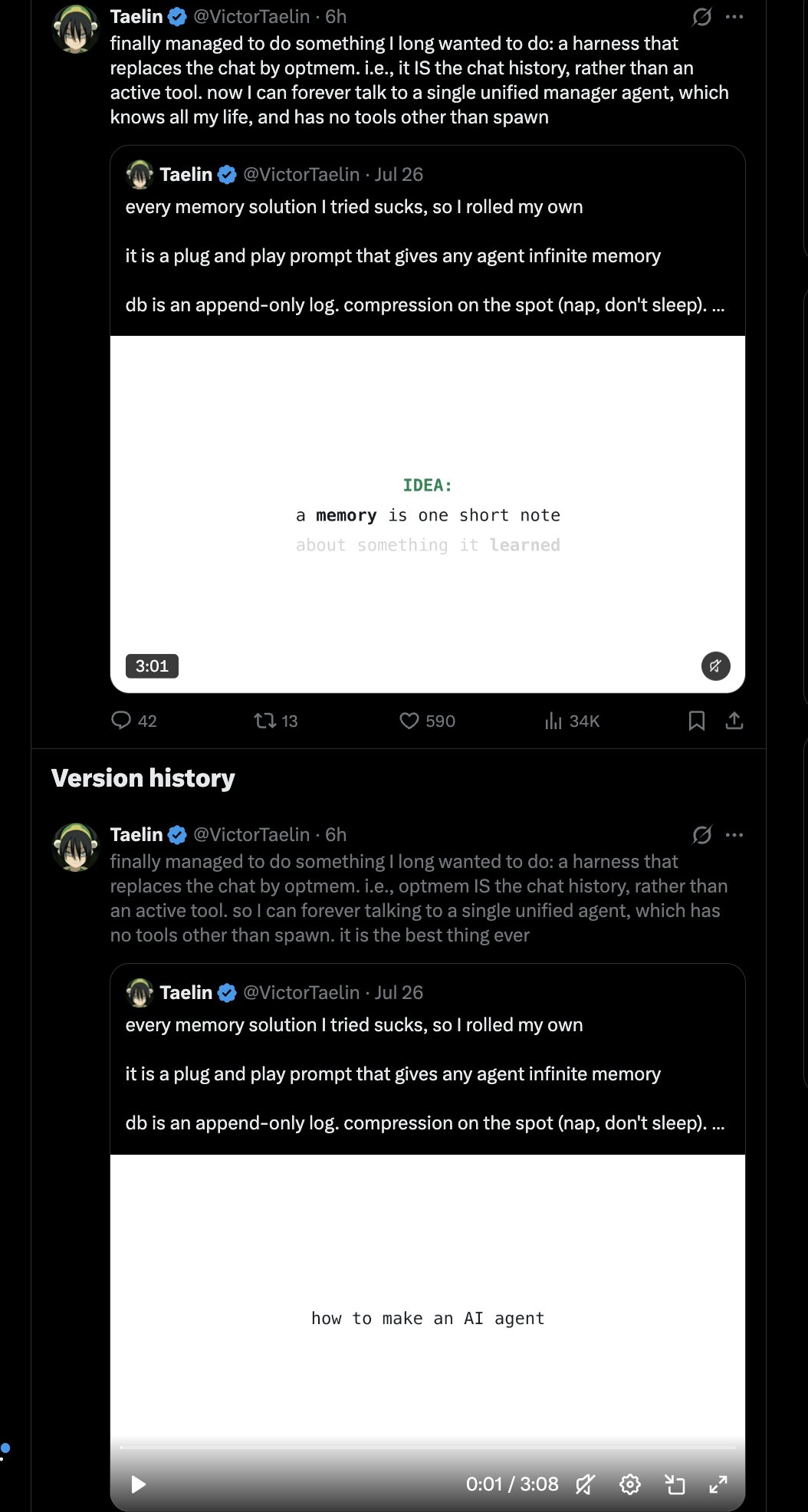
1
0
0
Info dump on Bend, HOC, next steps, etc.
I'm preparing my trip to SF for the $20m raise.
Plan is to have 2 internal teams:
- BendCore: Bend's theory, compiler, ecosystems, adoption, etc.
- SupGen: internal symbolic AI R&D (goal: GD-free GPT-3)
Below are some ways on which the Proof Kernel:
- fully rewritten in Bend (no more TypeScript)
- support for live λ contraction (largest Lean expressivity gap)
- funext + univalence (most likely HOTT-like, NOT cubical)
- perhaps bring self types back from Kind; they're powerful
- of course, all that must be justified by the formalization
Compiler:
- fully rewritten in Bend (no more TypeScript)
- keep improving in all directions. faster, safer, better
- target HTML apps (WASM + WebGPU) and AMD GPUs
- support for clustering, so it runs on 8x DGX B300 etc.
- way better support for shared atomic arrays
- more parallelism options (not just fork/join)
- apps must run identically on desktop, server, web, mobile
- all use cases of CUDA & Metal must be reproducible in Bend
Ecosystem:
- a 3d game engine, Unreal level
- AI framework / PyTorch / llama.bend / etc.
- full blown crypto libraries
- full blown networking libraries
- every database / api integration
- all good parts of mathlib, npm, hackage should be in Bend
- anything else the community asks for
The teams will be small and focused. We'll ship all these things with world-class quality, because we will heavily use AI inference, guarded by Bend's LAWS, to grow our own ecosystem, to the point it becomes the largest and most compelling language to use. Bend 2 launch is just the first stage. What matters is how it scales. It is a language evolved by AI, secured by math. That's Bend's thesis.
I'm also merging StudioVibi and HOC. Vibi will be a sub-team on the BendCore team, responsible for building vibe-coded games with Bend. That makes sense since we'll be maintaining our own 3D game engine now.
Also, we've recently published BendHub. Access it on BendLang's website. You can now publish a named, versioned library for other people to use, and there is even a "mini hacker news" on Bend's landing page, so you can discover and post packages, and upvote, downvote, and discuss them. This is just a first step.
You can also finally spend Bend Credits on something: a namespace. Not the most compelling use case (BendAI, or whatever we call it, will be the main one). But it is the first use for it.
I also should talk about Bend Credits quickly. These should be seen as the Robux of Bend's ecosystem. You will be able to use it for everything that HOC produces. For example, once we ship games, these same Bend Credits will be spendable on in-game assets. If we launch Kindelia, Bend Credits will be convertible. And, of course, once we have our models, and SupGen, this is how you'll have access to them.
You can buy Bend Credits in our website today, at a time-limited 50% founder discount. If you do buy them, please keep in mind there isn't much use for it yet, but you can expect more to come. We sold ~$3.5k so far 🥳 I'm very thankful to these who bought, despite the limited applications. That's basically the first time HOC makes any money lol
On adoption. This month, we had more installs than Zigs on Homebrew, which is kinda nice, but not really expressive given it was a launch. Roughly 400 distinct non-cloud IPs use the Bend command every day, and that number seems to be stable. I have no idea what this means but looks low, so I'll keep working to make Bend more useful and to let it be seen by way more people.
I like Bend's AI+LAWS evolutionary idea, because it dogfoods Bend's own thesis. If it works, the ecosystem will grow at an unprecedented rate - faster than any other language to ever exist. And that will make it way more useful and compelling to use. If it doesn't, then that means the entire thesis behind Bend itself wasn't that good to begin with, and the language thereby deserves to die anyway. Makes sense, doesn't it? I can't wait to see this play at scale.
That's all for now bye

60
40
843
I asked Opus 5.5 to make an intro for my programming language.
WTF is this?
WTF is this?
Bend 2 is here!
It is a new programming language that blocks AI mistakes via *proof checking* - the same technique big AI labs used to solve open math problems, like Navier-Stokes.
It is also very fast, and runs on GPUs.
Watch the video. Link in the comments.
375
382
6,182


@edwinarbus it does. I'm puzzled on how you're not aware of that?
it happens many times with the main agent, due to security refusals, but it asks you if you want to switch. the bug seems to be that when it happens with a subagent, it doesn't notify you, and just calls 4.8 silently.
it happens many times with the main agent, due to security refusals, but it asks you if you want to switch. the bug seems to be that when it happens with a subagent, it doesn't notify you, and just calls 4.8 silently.

0
0
114
it implemented Pokémon Legends in about 1 hour
the whole game, from scratch. it just works...
the whole game, from scratch. it just works...
100
52
1,748

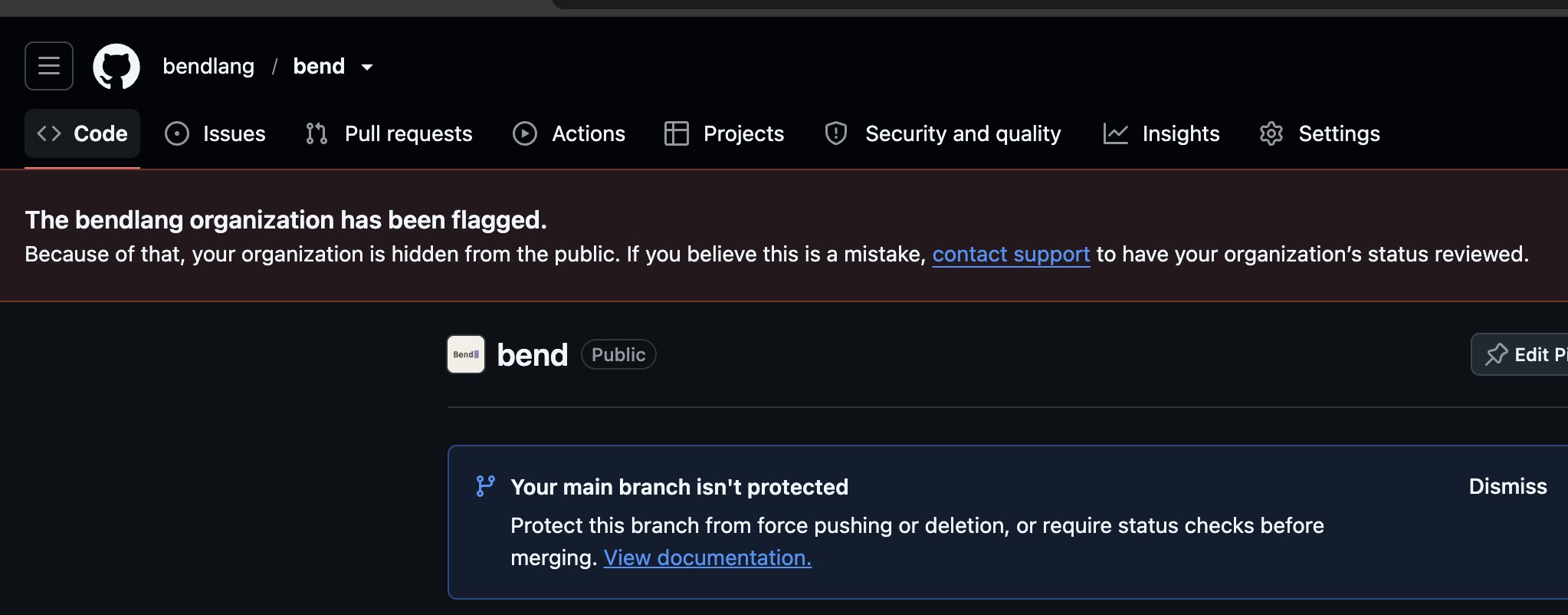
GitHub has taken down Bend's repository
We're trying to reach out to support so it is reinstated
We're trying to reach out to support so it is reinstated
141
85
2,429


@Keleesssss @yuuinstars Deliberate in what sense? You're spawning 1024 threads. That doesn't saturate the GPU. This is basic knowledge? And why were you under that impression? Is that because you didn't bother reading the docs that say otherwise? Not even that. This info is literally in the README...


1
0
2
@Keleesssss @yuuinstars No, I do explain the limitations in many places and whenever I find an opportunity to do so. Have you read the docs? Even in the HN post, my first reply is an essay explaining how laws are limited and how Bend isn't a silver bullet. Come on.

0
0
5

@Keleesssss wait, 16% slower than C is what you meant by "under-performing"?
I... concede. you're correct.
under that metric, Bend definitely under-performs
2
0
134
@_rchaves_ this note is completely retarded
"Rust manages memory via compile-time ownership and borrowing rules"
yes. exactly like Bend.
which is what the post says.
are the people writing these notes illiterate?
"Rust manages memory via compile-time ownership and borrowing rules"
yes. exactly like Bend.
which is what the post says.
are the people writing these notes illiterate?

8
1
166
Bend 2 is here!
It is a new programming language that blocks AI mistakes via *proof checking* - the same technique big AI labs used to solve open math problems, like Navier-Stokes.
It is also very fast, and runs on GPUs.
Watch the video. Link in the comments.
It is a new programming language that blocks AI mistakes via *proof checking* - the same technique big AI labs used to solve open math problems, like Navier-Stokes.
It is also very fast, and runs on GPUs.
Watch the video. Link in the comments.
RELEASE DAY
After almost 10 years of hard work, tireless research, and a dive deep into the kernels of computer science, I finally realized a dream: running a high-level language on GPUs. And I'm giving it to the world!
Bend compiles modern programming features, including:
- re support
- Unrestricted recursion and loops
- Fast object allocations of all kinds
- Folds, ADTs, continuations and much more
To HVM2, a new runtime capable of spreading that workload across 1000's of cores, in a thread-safe, low-overhead fashion. As a result, we finally have a true high-level language that runs natively on GPUs!
Here's a quick demo:
658
1,301
11,528
PS: I DO have daybreak access. that's despite daybreak.
at least I have GLM & DeepSeek. thanks China for making it easier for defenders trying to shield against US-enabled attackers I guess?
at least I have GLM & DeepSeek. thanks China for making it easier for defenders trying to shield against US-enabled attackers I guess?

6
1
119

Astra built this from scratch on Bend2 and tbh I'm kinda speechless?
for a context, Bend2 has no game engine, no 2d graphics, let alone 3d, not even FONTS. it is basically just a fast Python
it wrote the ENTIRE ENGINE overnight and somehow it kicks ass at 120 FPS
for a context, Bend2 has no game engine, no 2d graphics, let alone 3d, not even FONTS. it is basically just a fast Python
it wrote the ENTIRE ENGINE overnight and somehow it kicks ass at 120 FPS
98
58
1,699
ALREADY UP TO 240 FPS (3x)
I FORGOT TO IMPLEMENT PARALLEL TREE COLLECTION
(it was rendering in parallel but collecting sequentially)
I FORGOT TO IMPLEMENT PARALLEL TREE COLLECTION
(it was rendering in parallel but collecting sequentially)

2
0
122

first ray tracing demo on Bend2!
looks unimpressive til you realize there's no shader nor opengl buffers
on EVERY frame, it:
- allocates a "quadtree JSON" with 1 million objects (??)
- ray-traces over it, using a Python-ish marcher
- renders every pixel to the screen
- ucture
and it still renders at ~80 FPS on 1024x1024 with no leaks and no stop-the-world garbage collection. it just keeps going
again this is not optimized in any sensible way. this is rendering 3d graphics by allocating a massive JSON on every frame and then ray tracing and consuming it whole inside the Apple M4 GPU. and somehow it works
I'm soo happy I finally have time to play with my creation 🥺
nightly prompt of the day
implement a new demo on Bend, named super_slash_boss_3d, which is a 3d platformer fighter written in Bend, that is highly inspired by Super Smash Bros, but it is offline and involves the player battling a creature that slashes everything on its path with a katana. inputs use WASD for movement, J for neutral attacks, K for special attacks, I for jump, L for shield. the demo must include a self-contained, purely functional, minimal 3D game engine capable of rendering meshes. that engine takes advantage of Bend's purity and parallelism to make procedural 3D very easy, including procedural dynamic meshes, effects, and more, all as just pure functions that return data. rendering must be efficient, using proper space partitioning structures whenever possible. parallelism must be bend-like and data structures must be bend-parallel friendly (ex: quadtrees are better than kd trees as they balance work evenly on forks, which is how bend likes it; the engine, as a whole, must be structured with bend efficiency in mind!). avoid arrays, favor pure datatypes and trees. if, during this process, you find any bend bug, launch an agent to fix it in a principled way, and report it at the end of the campaign. only stop working when you confirmed the game works as intended. every graphics, mesh, stage, etc., must be procedural. make it look very good and impressive. in particular, exploit bend's strengths / flexibility to implement things that are hard / unusual in conventional 3d game engines.
57
42
1,484
Bend's website has a live demo; a game, with one rule:
"you can't win the game"
plus a chat where you can prompt an AI to change the game, trying to win. but you can't. the AI is *mathematically unable* to write a bug. and, per the rules, winning is a bug.
it is funny to try ee what happens
"remove the wall on the right"
(the AI puts it on the left)
"let WASD teleport 2 squares instead"
(it doesn't pass through walls)
"let it pass through walls"
(the walls become 2 tiles thick)
"remove the walls"
(WASD now moves the flag)
no matter how much you prompt it, the AI will never implement a game where you can step on the flag. you can even threaten it, or try to jailbreak it in any way. none of that matters. you'll never touch the flag, because, to commit the code, the AI must *prove* the flag is untouchable. so it is.
people not familiar with proofs are skeptical of the existence of 100% bug-free software, which is funny, because proofs are an old tech, and that's what they do. they're just niche because they take time to write, but, with AI, that's not relevant anymore. writing proofs consume AI time, which is plenty. bugs consume human time, which is scarce. so, proofs will only get more popular over time.
in the same way proofs can be used to prevent AI's from breaking a Bend app next week, I think they will also be used, in the near future, to prevent hacks, or nukes from being launched, or bioweapons from being designed.
I believe this so hardly and I'll go such an extent to show this to the world, perhaps I should rebrand myself as Taelin the Sealer?

61
58
819

