Pinned Tweet

While most people speculate on #DePIN tokens,
I operate the infrastructure behind them.
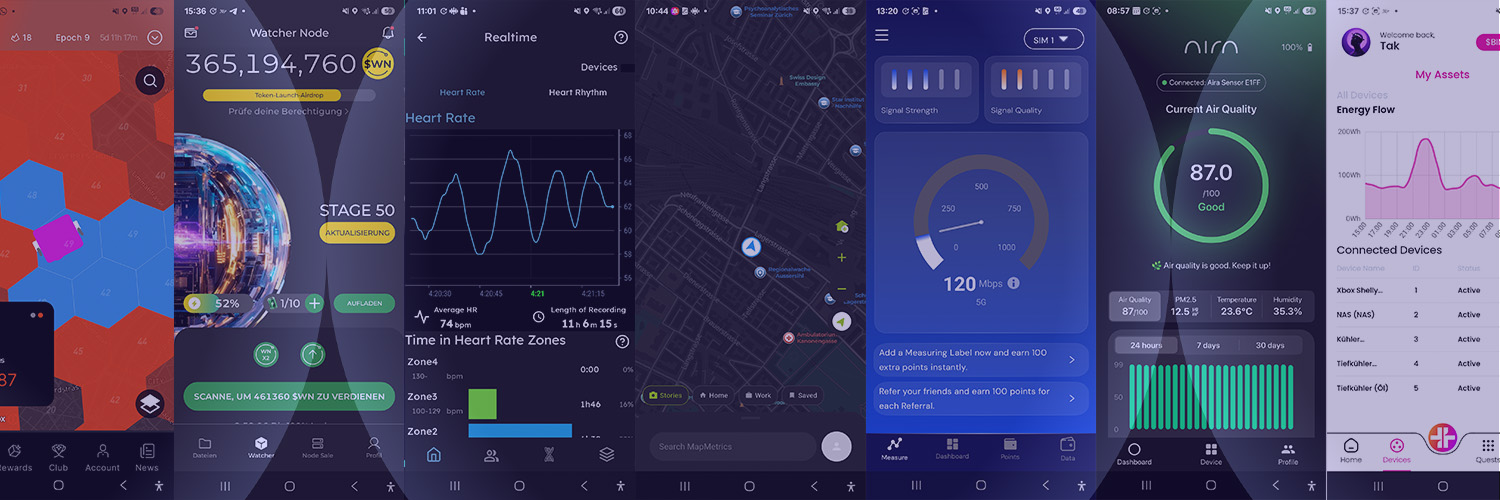
📡 Connectivity & Network Data
– @375ai (network & connectivity data → $EAT)
– @AnyoneFDN router (bandwidth sharing → $ANYONE)
– @roam_network (WiFi mapping & connectivity validation)
🗺 Mobility & Mapping
– @MapMetrics (anonymous travel data → $VAULT → $MMAP)
– @captur_go (mapping & geo-data collection)
🧠 Compute
– @Acurast phones (mobile compute → $ACU)
– @DATSProject node (desktop + mobile)
– @KaisarNetwork node
– @teneo_protocol AI agent (public data indexing)
💾 Storage
– @DeNetPro Storage node / Watcher node
🎙 Data Contribution
– @silencioNetwork (noise + voice data → $SLC / $USDC)
– @ReflexDAO (health metrics → $BEAT)
– @ScannitNetwork (receipt scans & microtasks)
🌍 Environmental & Energy
– @airalabs_io air quality sensor
– @shelly_IoT plugs + @combinderio (energy data → $BIND)
– @SkyX (weather data, soon)
💰 Capital Allocation
– RoboFarm RWA investment (monthly yield, tokenized agriculture)
– @peaq staking & long-term holding -> $PEAQ
I test these systems in the real world.
I collect data, rewards, and firsthand experience.
And I share honest conclusions — even when they’re inconvenient.
11
3
47
7,317
Stop. Spreading. Misinformation.
No, there is no massive scheduled ethereum:0x1eef208926667594e5136e89d0e9dd6907959197 cliff unlock on November 12. And no regular monthly unlock event either.
So why are token trackers showing 56 million, 82 million or even 96 million PEAQ that day?
@DefiLlama's unlock overview has listed ethereum:0x1eef208926667594e5136e89d0e9dd6907959197 as a "Cliff Unlock" involving roughly 2.17% of the circulating supply, while its detailed PEAQ page now describes a weekly unlock rate and explains per-block vesting. @CoinGecko and @TokenomicsCOM have also displayed large monthly unlock figures.
No wonder people are confused.
After @WendlerTill raised the issue, I went through @peaq's official tokenomics documentation.
The explanation is straightforward: Remaining investor and team allocations vest continuously, block by block. Tokens gradually become claimable rather than being released in one big monthly batch.
Some tracking platforms present these amounts as if they were suddenly unlocking on a specific date.
Now, let's be clear: The vesting is real. Additional tokens are becoming available over time, and they can eventually become transferable. But a month's worth of continuous vesting is not the same as a massive one-day cliff unlock.
Till also confirmed that peaq has already contacted some of these platforms to correct the information.
And honestly, I can't blame people for being confused. When established data providers present the same kind of event, why wouldn't you believe them?
Apparently, even ChatGPT has been repeating those numbers.
Credit to @WendlerTill for addressing this and continuing to clarify the situation.
A monthly vesting total is not a monthly unlock event. Time to get those calendars right.


9
13
87
2,686
The crypto market is bleeding. Meanwhile, @silencioNetwork just reported 113% quarterly revenue growth.
Revenue more than doubled from $300K in Q2 to $640K in Q3. Total revenue received so far in 2026: $1.04 million.
Silencio now reports four enterprise clients, including 1 AI lab that signed the largest contract in the project's history. The other two operate in AI agents and AI data services.
According to Silencio, all four clients have already placed repeat orders.
That tells me more about the potential of this business than any token chart.
But there's also news for $SLC holders. The $1 million revenue threshold has been crossed, and the first $30K in revenue-funded token buybacks is now scheduled for Q4. Not executed yet, but finally a concrete amount attached to the mechanism.
Silencio also expects more than $1 million in additional revenue during Q4 alone.
And what did $SLC do after the update? It briefly climbed to around $0.00036 before pulling back, while much of the broader market was still struggling.
Yesterday, I wrote that red candles don't mean nothing good is happening.
Today we have another reminder that there's a business behind those candles. And in Silencio's case, that business appears to be growing rather quickly.
Guess my Monday morning motivation aged pretty well. 😁

1
11
84
1,360
The robot is still on the workbench. Its token is already trading on @solana.
Sounds backwards? Maybe. But this could be how the next generation of robots gets funded.
I took a closer look at @orbie_robot on @machinedotfun: a real prototype, an ambitious price target below $500, and a new way for hardware startups to finance the journey to mass production.
And there's a reason @peaq is backing this idea.
Meet Orbie, a small, wheeled home robot being developed by @jaiswalashok and his team.
The idea is to make home robotics affordable. Instead of building another $20,000 humanoid, Ashok wants to create a robot that ordinary households can actually buy.
They're starting with pets. Orbie is intended to move around your home, check on your animals, observe their behavior and eventually recognize when something seems unusual.
I'm fairly sure my cats would immediately declare war on Orbie. But I guess that's part of testing a robot in the real world. 🤖 ❌ 🐈⬛
The team has already built working prototypes, published open-source code and shared videos of the development process.
And now they've launched solana:HEb2dwDNbBhnrCusoNXXvba9MymYTTmMQcHKaptxmfun on machine.fun.
Building hardware is expensive. You need components, prototypes, testing and eventually manufacturing. All of that costs money long before you can sell your first finished product.
machine.fun offers a different approach. Builders can launch a token, build a community around their project and receive a share of the trading fees to help fund development.
The token is already trading. The robot, meanwhile, is still being developed.
And that's an important distinction. A successful token launch doesn't mean a finished product, and market cap isn't the same as money raised for manufacturing.
But imagine Orbie actually making it into thousands of homes. Those machines could eventually run peaqOS, giving them digital identities and access to the wider Machine Economy.
That's the bigger idea behind @peaq supporting machine.fun: help hardware builders get started, then provide infrastructure as their machines become real products and, hopefully, growing fleets.
Of course, there's still a long road from a prototype on someone's desk to a robot you can buy for your living room.
But I find it fascinating that we can now watch that journey unfold in public. And perhaps even help finance it.
Now let's see whether Orbie can make the jump from the workbench to mass production. x.com/jaiswalashok/s…
2
1
20
634
The crypto market sucks right now. No point sugarcoating it.
And $SLC is getting dragged down with it, despite @silencioNetwork having delivered some pretty significant updates lately.
Silencio recently confirmed that @ElevenLabs is using its voice data for AI. That's a major de. And on top of that, $SLC has expanded from @peaq to @solana.
And according to @AlexM_SLC, more big announcements are planned for this week.
In a different market, news like this might have sparked a lot more excitement. Right now, it seems like everything gets swallowed by the sea of red candles.
But here's the thing: A bad market doesn't mean good projects have stopped making progress.
Prices can fall while businesses keep growing. Announcements don't guarantee green candles, of course, but neither do red candles mean nothing good is happening.
So if the market is getting you down, don't forget to look beyond the charts once in a while.
Some projects are still delivering. Even when everything is red.
And @silencioNetwork is giving us some pretty good examples of that.
Guess this is my Monday morning motivation. ☕

6
7
77
2,009
Wait...@peaq x @Samsung ? 👀
Now THAT would be something.
I've been Team @SamsungMobile for well over a decade. And I've been Team @peaq for quite a while, too. So you can imagine my reaction when I saw both names appearing in the same announcement.
Not the big partnership ve hoped for, but pretty interesting in its own right.
Machines running peaqOS can now interact with devices connected through Samsung's SmartThings ecosystem.
With this integration, an authorized robot can unlock a door under its own digital identity, without borrowing someone's login.
Or imagine an office cleaning robot switching lights on as it works and off again when it leaves. Or several delivery robots sharing a charging depot, each with its own access permissions instead of one shared PIN.
peaqOS handles the identity, permissions and a traceable record of the commands. SmartThings handles the connected devices.
We talk about robots changing the world. But sometimes, the next big step is solving a rather ordinary problem.
@peaq keeps opening doors for the Machine Economy. This time, quite literally.

3
19
108
1,930
Well, $SLC is officially live on @solana. Mystery solved. 🕵️
Not that it was the hardest mystery to crack. @silencioNetwork practically painted the clues in Solana colors. Doesn't mean I'm any less happy about the news, though.
But there's still one piece of the puzzle I'm curious about.
@peaq recently said that millions of Silencio sensors already run peaqOS. What does that actually mean for those of us using the Silencio app on our smartphones?
Does my phone have its own peaqID? Is there a verifiable record of the data I've contributed? And how does peaqOS fit into the process?
@peaq and @silencioNetwork, enlighten us! x.com/silencioNetwor…
3
4
64
1,395
Okay, @peaq and @silencioNetwork. You have my attention, but I'm not sure I'm connecting the dots the right way.
So here's my theory.
$SLC has been making some impressive moves lately, despite a pretty miserable crypto market. No idea what's driving the price, but the timing of ht my attention.
First, Silencio posted a mysterious teaser featuring its logo in what look suspiciously like Solana's colors.
Then Silencio publicly contacted @coinmarketcap, referencing ticket #1470477, and asked @coingecko to update its description.
I don't know what those changes involve, but it's quite a few things happening at once.
And then peaq dropped this:
"Millions of Silencio sensors already run peaqOS. Guess where they're heading next."
The hint was @DualMintRWA, which already combines Solana with peaqOS-powered machines.
So my first guess is that Silencio is expanding to Solana, while peaqOS continues to provide the infrastructure for its devices.
But there's another part of peaq's announcement that caught me completely off guard.
Millions of Silencio sensors already run peaqOS?
Wait a minute. What sensors?
I've been using Silencio for a long time. I used my smartphone to measure noise levels, and now I use the same phone to record voice data for AI companies.
Does peaq mean that these smartphones are already connected to peaqOS? And if so, does each device get its own verifiable machine identity?
Because that opens up a few possibilities.
Imagine my phone having its own registered identity, a history of completed recording tasks and perhaps even a reputation based on the quality and reliability of the data it contributes.
Silencio would connect the device to customers who need voice data. peaqOS could provide the identity and verifiable work history. And Solana could handle tokens and payments.
That's speculation, of course. We don't know whether individual smartphones are registered this way, whether reputation is involved or what Silencio actually plans to do on Solana.
But here's why I find the possibility so fascinating.
I already have six old smartphones working for @Acurast, providing computing power. And now my everyday phone, which I use for Silencio recordings, might also be a registered machine in the peaqOS ecosystem.
Apparently, I'm slowly turning into a one-man Machine Economy.
So, @peaq and @silencioNetwork: am I connecting the dots, or have I just invented an entire product roadmap for you?
And there's one more dot.
@sjdedic recently wrote that larger investors and liquid funds are only now starting to pay attention to $SLC, but that the vast majority are still sitting on the sidelines because of insufficient liquidity.
Now, Solana doesn't magically solve liquidity problems. But access to its DeFi ecosystem could open up new options for trading and liquidity provision.
Could that be part of the reason for the move?
Interesting...

10
17
150
6,179
I completed a 100-day quest on @roam_network a few days ago and I was looking forward to the next one...
Today @roam_network announced they're shutting down.
That hurts.
#DePIN is a bet. Sometimes it pays off. You collect data, provide bandwidth, storage or compute and metimes you spend months contributing, collecting points and completing quests, hoping that eventually it will lead somewhere.
Then it doesn't.
@charge_xyz: gone.
@ScannitNetwork: gone.
@MapMetrics: technically still here, but somehow also not.
And now @roam_network joins the list.
To be fair, it's not always about money. Climbing a leaderboard can be fun. Completing a long quest feels good. A streak gives you a reason to come back tomorrow. I've spent ridiculous amounts of time doing exactly that, and I enjoyed some of it.
But that's also part of the risk we take as DePIN users. We don't only contribute data, bandwidth, storage or compute. We contribute our time and attention.
Sometimes we get tokens for it. Sometimes we get a useful product, a community or simply the satisfaction of reaching the top of a leaderboard.
And sometimes a project you've spent months contributing to simply disappears.
That's DePIN too.
And the best part? A few hours after announcing the shutdown, the app prompts me with "Update available."
You literally can't make this up.

11
1
13
1,351
In case you're lost on Crypto X.
What did I miss? Add your translation below. 🔽
(Text: me / Image: AI)
What did I miss? Add your translation below. 🔽
(Text: me / Image: AI)

0
1
6
299
Delivery robots paying for their own electricity. Machines taking out loans.
I looked at what the 5 winners of the @peaq / @SuperteamDE hackathon actually built. This is what the Machine Economy looks like.
🥇 @R0boPay: payments for machines
RoboPay built a payment system for in the physical world. Their prototype uses a delivery robot: the payment is set aside before the delivery, the robot completes the job and proves it, and only then is the money released.
@solana handles the payment, peaq gives the robot a verifiable digital identity, and Staex provides secure connectivity. The current version already works with a real small delivery robot and a QR code, while additional verification through the letterbox is planned.
🥈 FieldProof by @excelhtf: software buying fresh data from machines
FieldProof lets software pay device operators for fresh information from the physical world. A piece of software could ask something as simple as: "Is this door open right now?" A sensor performs a new measurement, signs the result and the operator gets paid.
The prototype already works with a real sensor. peaq gives that device an identity and records its work history, so the buyer can verify which registered device produced the reading. Importantly, this proves that the device made the claim, not that the claim itself must be true.
🥉 Fiducia: giving machines spending rules
Fiducia explores what happens when machines are allowed to spend money themselves. In its demo, a delivery robot earns money, needs electricity and chooses between different charging stations based on price and track record.
But the owner remains in control. The owner decides in advance which providers the robot may use, how much it may spend on one charge and how much it may spend in total. The robot, driving and charging are simulated, but the peaq machine identities and activity records and the Solana transactions are real.
4️⃣ SKIM — credit for machines
SKIM asks a fascinating question: if a machine generates revenue, why couldn't it borrow against that revenue?
A machine receives an advance. As it continues earning money, part of every payment automatically goes toward repaying that advance. Its digital machine identity acts as security until the money is paid back.
And just like with humans or companies, building a good financial track record matters: repay successfully and the machine can qualify for a larger and cheaper loan next time.
The team has already run and repaid two test loans on peaq's Agung testnet, although the credit ratings used there are simulated.
5️⃣ @Desc_Protocol: escrow with AI arbitration
DeSC tackles another basic problem: how do two parties transact when neither wants to trust the other?
USDC is locked in a Solana escrow contract and the work is delivered. An AI moderator chosen beforehand checks the delivered files against the agreed criteria. If the work passes, the contractor gets paid. If it fails, the buyer gets refunded.
It's currently running on Solana Devnet, so we're still talking about a prototype rather than a production system.
Put these five projects together and you get a pretty good picture of what a Machine Economy could look like.
Machines earn money. They spend it. They buy data and services from other machines. They build a financial track record, take out loans and prove that work was actually done.
peaqOS provides a foundation for that: digital identities and verifiable history.
@peaq isn't here to build every piece of the Machine Economy.
It's here to make sure they all work together.

8
16
145
3,129
Well... we're back here again. 😅
A few months ago my @AnyoneFDN dashboard suddenly showed 0 registered relays while my Anyone Router was happily running in the background. It turned out to be an indexing issue and was eventually fixed.
Now the exact same thing seems to be shboard currently shows:
→ 0 registered relays
→ 0 claimed relays
→ 0 active relays
→ 0 claimable relay rewards
The last time I checked, I had more than 120 $ANYONE waiting to be claimed.
Meanwhile, the router itself couldn't look much healthier: relay running, client online, OR-Port reachable and all the nice FAST, STABLE, RUN, V2Dir and GUARD flags are there.
So I'm not touching anything.
Anyone else seeing this again, @AnyoneFDN?

2
1
7
663
$SLC: +700% in three months!
I know this sounds like an "I told you so" post, but I don't predict prices. I judge projects by their business model, their execution and whether people are actually willing to pay for what they build.
So forget the price for a moment and look at encioNetwork:
✅ 2.5M+ contributors across 180+ countries
✅ 1M+ hours of off-the-shelf voice data
✅ $250,000 contract with one of the world's leading Voice AI companies
✅ Biggest deal in Silencio's history signed with a frontier AI lab for African voice data
✅ 2026 revenue expected to cross $1M
✅ $40M+ active enterprise pipeline across 50+ leads
✅ 5 of the world's top 10 AI companies have already inquired about Silencio's data
And there could be much more ahead. AI models are still hungry for voice data, especially across languages, dialects, accents and regions where high-quality datasets are difficult to find.
Once Silencio reaches a $1M+ cash reserve, the company has committed 75% of data-sale revenue to the BlockSound Foundation, which will use it to buy $SLC on the open market and burn it.
So if the business grows, there is a direct mechanism designed to turn part of that revenue into buy pressure and permanently reduce supply.
AI company needs data → Silencio mobilizes contributors → contributors get paid → Silencio generates revenue → revenue can eventually fund $SLC buybacks and burns.
That's a #DePIN model I understand.
And judging by the growing commercial interest and the recent price action, it looks like more and more people are starting to understand it too.

4
11
64
1,809
Yesterday I wrote that $SLC was up 27% in a week and explained why I like @silencioNetwork.
Apparently I need to do that more often.
What the hell happened here? 😂
Apparently I need to do that more often.
What the hell happened here? 😂

9
3
53
1,193
Most of the crypto market is bleeding.
Meanwhile base:0x6bd83abc39391af1e24826e90237c4bd3468b5d2 went up 27% in one week.
Why? As always: No idea. 😂
But I can give you a few reasons why I think @silencioNetwork is one of the best #DePIN projects.
First of all, I love how u don't need special hardware. You don't need to run a node. You just need a smartphone. Record your voice. Contribute speech data in your language. Get rewarded for it with $USDC and base:0x6bd83abc39391af1e24826e90237c4bd3468b5d2 .
And with 2.5M people in the network, that becomes especially interesting for languages that aren't spoken by hundreds of millions of people.
Silencio says it collected 100,000+ hours of voice data across 45+ African languages in just eight months. Some of those languages barely have any commercial speech datasets available at all.
And the market for that data is real.
@thomasmesserer recently pointed out that one Voice AI lab committed hundreds of millions of dollars to collecting data across 22 languages in a single country.
That's not money going to Silencio. But it tells you something about how valuable good voice data can become.
Does any of that explain base:0x6bd83abc39391af1e24826e90237c4bd3468b5d2 going up this week?
No idea.
But while most of my portfolio is currently doing its best impression of a falling knife, I'll take it.
I only have one complaint:
When do we finally get a Swiss German campaign?
Gopfetammi! 🇨🇭😂

4
8
60
2,530
This is how peaqOS opens doors to a new economy.
Literally, this time.
@peaq just demonstrated a delivery robot interacting with a building it had never been integrated with before. No custom code for the door. No custom code for the sensors.
The robot used its peaqOS identity to discover the devices around it, saw that the loading area was occupied, waited until it was clear, opened the door and drove in.
Simple demo. Bigger idea.
And that's what I've been noticing with peaqOS lately. Almost every week there's something new. New functions. New integrations. New types of machines using it. New ways for machines to identify themselves, prove things, discover services, interact and eventually transact.
Piece by piece, it's starting to look less like a collection of individual features and more like an actual operating layer for machines.
I just hope robotics developers are paying attention. Especially the big ones.
Because if we're really heading towards an economy with millions or even billions of machines, they can't all live in their own little isolated worlds.
Robots in Korea can now talk to the buildings around them
Korea runs 1,220 robots per 10,000 employees, more than anywhere on earth. And the Korea Electronics Technology Institute (KETI) built Mobius, an open platform for a building’s sensors and doors, on the global oneM2M , a machine running peaqOS can use it on peaq’s robotic.sh. Watch a delivery robot read a building it has never seen, wait for its moment, and open the door itself.
→ peaqOS provides identity, discovery, and coordination
→ KETI’s Mobius speaks for the building
robotic.sh/services/keti

1
5
49
889
If you're staking $PEAQ through the @NATIXNetwork validator, check your staking position.
I just realized that I haven't received any staking rewards for quite some time.
I've had 50,000 $PEAQ staked with the NATIX validator, and everything looked normal in the staking ds weren't moving.
So I asked around, and @0xEl9ar9ni checked the blockchain for me. NATIX apparently last authored a block on September 5.
And since validators and their stakers only receive rewards when the validator authors blocks, that explains why I haven't been receiving any.
I've informed @peaq about it as well and I'm changing my validator now.
If you're also staking with NATIX, you might want to check yours.
I'm posting this because I had no idea anything was wrong. From my side, the staking dashboard still looked completely normal.

8
8
84
3,274
“With Web 3.0, we no longer need a middleman. It's time we cut him out.”
I still remember that line from one of @peaq's videos more than two years ago.
It was one of the reasons I started paying attention to @peaq – and to Web3 in general.
And the idea hasn't really changed.
it clearly has.
@MartinElKhouri recently described where peaq wants to go:
“The goal is to be the de facto standard. The financial standard for the Machine Economy. That is what we're building it for.”
From cutting out middlemen between people and machines...
to trying to build the financial standard for an economy of potentially billions of machines.
Same idea.
Much bigger scale.
And more than two years later, I'm still part of it. On a tiny scale, sure. But it feels good to contribute my little piece.
2
2
30
1,418
2.5M+ machines are already online on machines.peaq.xyz. And the number keeps growing.
Some of them move around as robots.
Others might be sitting on a desk in your home.
That's something I think is easy to miss when we talk about the Machine Economy.
“Machine” doesn't just mean humanoid robot.
As @MartinElKhouri explained on the @CryptoCoinShow, it can be sensor networks, drones, cars, airplanes, humanoid robots, service robots or collaborative robots.
That's a pretty wide definition.
A small sensor can be a machine. A smartphone providing compute can be a machine. A robot working in a factory can be a machine.
And suddenly, Martin saying that millions are a small number and @peaq wants to eventually reach billions of machines sounds a lot less crazy.
Some of those machines might already be in your house. I count 6 smartphones in my office and they will all be part of this economy.
That’s the scale @peaq is building for: not a world with billions of robots, but a world where billions of machines can participate in the economy.
1
5
57
1,269
At what point does dedication become stupidity? And when does it become money?
“I admire your dedication bro.”
This comment by @mgt_felix under my latest @Roam_network post is a nice compliment. But it also made me think about how much time, money and hardware I've actually put st couple of years.
Phones. Routers. Sensors. Smart plugs. Storage. Bandwidth. Compute. Data. And probably thousands of hours of testing apps, completing quests and collecting points.
And I'm starting to see a pretty clear divide. Some projects have turned that participation into something real.
With @silencioNetwork, I contribute voice data that can be used by Voice AI companies, and I've been rewarded in $SLC and $USDC. Quite a decent amount if you put in the time.
With @Acurast, my old smartphones provide compute and earn $ACU.
My @AnyoneFDN router provides bandwidth to a privacy-focused routing network and earns $ANYONE. 5 a day, which is pretty nice.
My @DeNetPro node provides storage and earns $TBY, although the amount is still tiny.
My @375ai_ app earns $EAT, but the fees to claim my token are higher than the actual value of the tokens.
With @airalabs_io, I carry an air quality sensor around with me. There are no points or tokens to collect and I don't earn anything from it, but the team keeps shipping updates and developing the product.
And then there's the other side of my #DePIN portfolio: Points. Lots and lots of points. Points at @DATSProject or @roam_network. Points and Fragments at @teneo_protocol. XP, $MMAP and $VAULT at @MapMetrics, which seems dead. $NANO at @SkyX_Network or $BEAT from @ReflexDAO, both of which have been silent on X for several months.
Quests, streaks and rewards that may or may not become something eventually.
And yes, I know there are other DePIN projects out there that are delivering.
I'm not saying every early-stage #DePIN needs to generate meaningful income immediately. But after spending this much time actually using these products, I've become much more interested in very simple questions:
What is the value loop? What am I providing? Who needs it? Who pays for it?
And how does some of that value eventually make its way back to the people providing the resource?
“Keep collecting points and wait” gets less convincing the longer you've been doing this. Maybe that's what dedication teaches you eventually. 😂

1
1
9
427