Jason Furman retweeted

In June 2002 CEO of Tyco, Dennis Kozlowski, resigned amid a ~$1M personal sales-tax case over art purchases; Tyco stock fell 27% that day. Few would read that loss to reflect his marginal product. Rather, markets were updating about deeper problems at Tyco, and rightly so. Cline-Walkling-Yore (JFE 2018) analyze this systematically, and find that this pattern holds for generally; personal scandals often predict later trouble at the firm.
1
3
22
3,744

I feel like I don’t get enough credit for my prescience.
I first called the Tesla bubble in April 2017 when they surpassed Ford and GM. Not in writing but I promise I did, really.
And now their stock price is down 20% from its high.
I first called the Tesla bubble in April 2017 when they surpassed Ford and GM. Not in writing but I promise I did, really.
And now their stock price is down 20% from its high.
18
6
197
22,951
Jason Furman retweeted

Yes, here is another example where CEO pay is well below market value marginalrevolution.com/marginalrevolu…
2
6
84
16,944
In today's class I asked students for creative examples of externalities.
The winner: Getting a tattoo is a negative consumption externality because it raises the chances a cannibal decides to spare you and eat the person next to you instead.
The winner: Getting a tattoo is a negative consumption externality because it raises the chances a cannibal decides to spare you and eat the person next to you instead.
11
19
350
26,301
A clever piece, literally running FRB/US on tariffs does result in higher investment--as John correctly notes.
I believe that says something about limitations in FRB/US which is why I made the modeling choices I did in simulating the tariffs. But props to @carney for doing this.
I believe that says something about limitations in FRB/US which is why I made the modeling choices I did in simulating the tariffs. But props to @carney for doing this.

5
3
38
14,762
As I said in the note, not my favorite model to use for tariffs.
On your issue, the fall in tariff-related equipment prices in FRB/US is an artifact of consumer prices up, it doesn't want overall prices up by as much, so it forces the residual into investment prices.
Plus the cost to a business is the equipment plus the customs duty, and FRB/US doesn't handle that.
Overall capital goods paid about one-third of tariffs, inputs up in price, and past episodes seem to have reduced investment.
That said, tariffs affect different industries very differently and in some your effect would predominate. Unfortunately FRB/US doesn't have industries so can't model that--why it's not my favorite model for this.
0
0
4
5,169
The large decline in NVIDIA's stock price suggests that the marginal product of at least some CEOs is extremely high--often well above their compensation which can be restrained by norms.
75
65
884
98,045
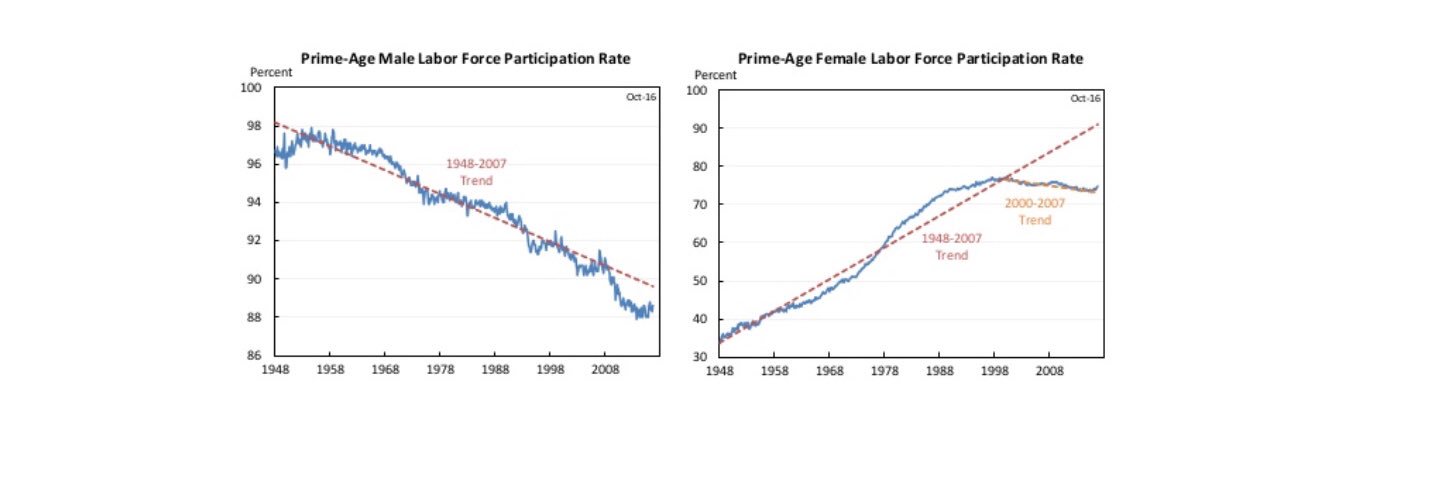
Post-9/11 Veterans had a tough time in the labor market for ~15 yrs after the wars started. They caught up w/ comparable non-veterans around 2019. Over the last year those gains have started to be undone. Why: 15% of them work for the Federal govt compared to 2% of non-veterans.

4
4
26
8,549
I did the work on this chart and explanation interactively with Claude Code and then asked it to write a blog to help me understand and explain it better. Here is the blog--not edited by me. econvitals.org/briefings/ai-b…
1
0
6
3,316
Jason Furman retweeted

Just had Fable 5.2 make a video explainer of my technology bottlenecks paper. I think this is a golden age where reading and digesting academic research will become so much easier (and more fun!) with these tools.
A big part of my daily work is to quickly make sense of new ools like these are so helpful for frontier knowledge work.
A big part of my daily work is to quickly make sense of new ools like these are so helpful for frontier knowledge work.
Since the version I last shared, I made four changes.
- First, I incorporated the publicly available usage data from Anthropic and OpenAI to extend our current "capabilities only" bottleneck pressure score to also account for usage, and ranked occupations by this usage-adjusted entral task-level result holds with both usage sources: the same task faces different pressure across jobs. The task rankings remain similar, although the occupation rankings change substantially. For example, writers and computer programmers rise to the top under the usage-adjusted construction with Claude data. While much of their work is rated AI-feasible, accounting for usage leaves more of their work outside AI use, moving them closer to the even split where occupation-level pressure peaks.
- Second, I added an empirical prediction. I show that bottleneck pressure also predicts faster posting growth after 2022, beyond what linear exposure or observed AI use would predict.
- Third, the same AI-infeasible task faces more pressure, on average, in senior postings than junior ones within the same occupation in every year since 2018, and about 6.5 percent more in the first half of 2026. This reflects how jobs are designed along the career ladder. Whereas senior postings surround the same hands-on or interpersonal tasks with planning and scheduling work that AI CAN speed up, junior postings carry much more hands-on physical work that remains AI-infeasible.
The gap reverses in information-intensive jobs such as accounting and credit analysis, where junior work is already mostly AI-feasible.
- Fourth, mean occupation bottleneck pressure rose 6 percent from 2018 to the first half of 2026, holding AI feasibility fixed, with nearly all of the rise by 2023. About 75 percent of this rise reflects advertised task mentions shifting away from low-pressure occupations rather than pressure rising within them. Basically, advertised work is shifting toward occupations that mix work AI can do with work it cannot (yet).
In the abstract below, the first two results are highlighted in purple and the third and fourth in teal.

2
6
83
9,234
Jason Furman retweeted

After the CPI release, by 11:05 ET: 2-year yield +12 bp, 10-year +9 bp. Fed funds priced for after Dec 9 rose to 4.18% from 4.14%, +31 bp over the current 3.875% target midpoint. S&P 500 futures -0.9%. Dollar index +0.5%.

0
2
20
5,189
Jason Furman retweeted

This Wednesday, Harvard Undergraduate Abundance will host @mattyglesias to discuss the future of American prosperity with Professor @jasonfurman. All students in the Boston area are welcome! Sign up to attend here: luma.com/gxbeu0sd
0
2
7
3,336
No refuge in today's CPI report. Very hot numbers across the board. Trimmed mean looks set to be even worse than core.
After the strong jobs report last week the only question left for December's FOMC is one hike or two.
After the strong jobs report last week the only question left for December's FOMC is one hike or two.
5
2
32
5,027
There are two investment booms right now. Everyone knows about one of them. The other is oil and gas.
All other business investment is up at a 2% rate over the last year.
All other business investment is up at a 2% rate over the last year.
Real data-center-related investment rose 21 percent over the past year and oil, gas and mining 13 percent, both above the 2 percent for all other business investment. Oil and gas are a much smaller share, so even rapid growth barely moves the overall economy.

6
20
71
10,122
Excited to share this tool--a Macroeconomic simulator that lets you run the Federal Reserve's large macroeconomic model FRB/US.
It has 13,442 different simulations pre-loaded--different versions of 15 different shocks.
I plan to add more models over time.
Here is a Fed hike.
It has 13,442 different simulations pre-loaded--different versions of 15 different shocks.
I plan to add more models over time.
Here is a Fed hike.

🆕 New on Econvitals: a Macroeconomic Simulator that runs the Fed’s FRB/US model on the shock you pick, from rate hikes to tariffs.
A 1-point rate hike that lasts a year: real GDP down by as much as 0.58%, unemployment up by as much as 0.32 points.
econvitals.org/tools/macro-si…

9
59
374
37,731
I also used FRB/US to run several alternative histories: what if the 2009 stimulus was larger? Or the 2021 one smaller? Or the Fed moved sooner to combat inflation? Or the Russian full-scale invasion of Ukraine never happened? Read them here--plus caveats. jasonfurman.org/research/what-…
3
1
16
9,591
Jason Furman retweeted

really excellent piece on the growth impacts of the AI buildout.
essentially, GDP has benefited almost entirely from the wealth effect, with ambiguous effects otherwise as income flows to Korea and Taiwan.
FRB/US (and Eric, fwiw) suggests a deep bear market would be c growth whereas a halt in the buildout alone wouldn’t do much on its own.
essentially, GDP has benefited almost entirely from the wealth effect, with ambiguous effects otherwise as income flows to Korea and Taiwan.
FRB/US (and Eric, fwiw) suggests a deep bear market would be c growth whereas a halt in the buildout alone wouldn’t do much on its own.

✍️ New from Jason Furman: The AI Boom’s Two Engines
So far the AI economy is less a story about data centers than about the stock market—and that is also where the risk is.
econvitals.org/posts/2026-11-…

4
30
169
22,057


New piece on the economics of the AI buildout based on running it through the Fed's FRB/US model.
Short version: The stock market increase has been an even bigger deal than the actual infrastructure build.
Will share more later.
econvitals.org/posts/2026-11-…
Short version: The stock market increase has been an even bigger deal than the actual infrastructure build.
Will share more later.
econvitals.org/posts/2026-11-…

12
26
139
18,950
And Econvitals now has a macroeconomic simulator you can use for a wide range of shocks and policies.
econvitals.org/tools/macro-si…
econvitals.org/tools/macro-si…
1
0
6
4,024